



Knowing when to fold preflop comes down to four spots where players keep hands they should let go: defending the big blind, facing a 3bet, facing a 4bet and facing a 5bet shove. In the first three, position, playability and your opponents’ ranges matter more than raw pot odds. Against a 5bet shove, pot odds and rake decide the call.
Nobody likes to fold in poker. It’s much more exciting to take a shot at the pot and find out what our opponent holds. And yet, well-timed folds are usually what separates break-even players from big winners.
In the early days of online poker, players defended their big blind with hugely tight ranges, often pocket pairs and strong broadway hands only. Any modern professional would find those ranges impractically tight. The game has since swung the other way, and that’s where most missed folds now come from.
Defending the Big Blind
The poker community eventually realised that loosening up from the big blind was necessary. That trend has continued to the point where many players now use absurdly wide big-blind defending ranges.
Take a look at the following range:
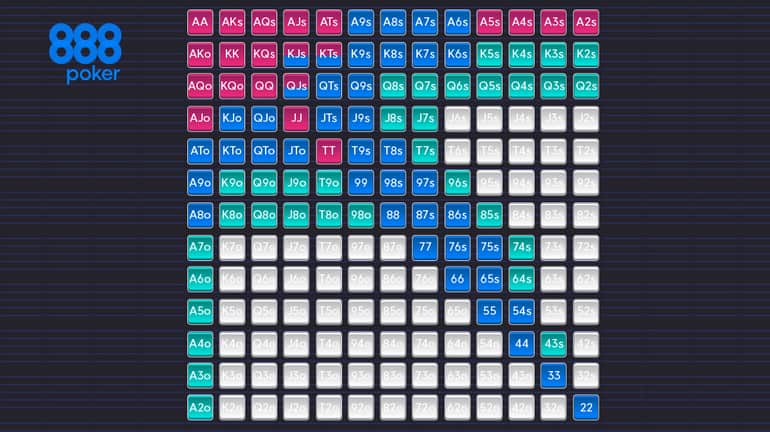
Imagine we’re defending from the big blind against a 3bb button open in a low-limit online cash game with 100bb effective stacks. The strongest category of hands on the grid is recommended for 3betting, and the mid-strength category is recommended for calling. The weakest category should only be called for a specific reason, and anything uncategorised should be folded by default.
Three factors explain why this range is tighter than many players defend:
- Rake is high. Even if a hand should be defended preflop in theory, that doesn’t mean it should be defended in practice. The hands at the bottom of a theoretically correct defending range should usually be folded because of rake costs.
- We’re out of position. Players tend to overrate pot odds in preflop decisions. With 100bb stacks, the postflop playability of our hand matters far more. Out of position, many hands underperform their raw equity, so a hand like K2o can get the direct pot odds to call against a button opening range and still be a fold.
- We need to be realistic about our own ability. A hand being a correct defend in theory doesn’t mean we should defend it. The wider we defend, the harder our postflop decisions become, for ever-smaller gains in winrate. The postflop mistakes we make with the weakest hands in a theoretical range are often enough to wipe out the small profit those hands were supposed to earn.
Pushing defends right up to the theoretical line takes a lot of skill. A tighter range we can play well postflop is more profitable than a wider one that leaks winrate.
So, anything in the weakest category on the grid isn’t an automatic defend. With a good reason (such as the chance to play against weak opposition), we can call. Otherwise, we fold and stick to the standard calling range, because most of those weaker hands damage a player’s winrate.
Defending vs 3bets
Game theory solvers tend to defend quite wide against 3bets. Copying those ranges is a problem, because solvers assume opponents 3bet as often as theory suggests. Total 3bet frequencies around 8% to 10% are typical in theory, while the average opponent only 3bets around 5% to 6%.
Rule: Against opponents who 3bet less than they should, fold more often to make up for their lack of aggression.
For example, take a look at the following defending range when facing a 3bet from the blinds after open-raising from the button.
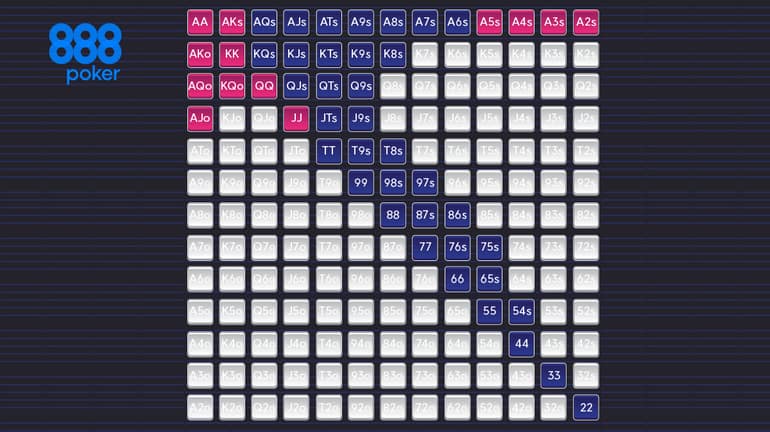
Defending this range means folding too often from a theory point of view, and that’s the whole point. We defend tighter than theory recommends to exploit our opponent’s lack of 3bet aggression.
Our defending range isn’t built on pot odds either. Some relatively high-equity hands (like A9o) don’t make the defending range because they play poorly, while some low-equity holdings (like 86s) can be defended thanks to their playability.
Defending vs 4bets
As with 3betting ranges, the average player’s 4betting range is significantly tighter than it should be. We exploit this by folding more often against 4bets than is theoretically correct.
4bet spots also show why preflop decisions can’t be made on pot odds alone. Imagine the following scenario.
Hero is dealt K♠️Q♠️.
Villain BTN open-raises to 3bb.
Hero BB 3bets to 10bb.
Villain BTN 4bets to 20bb.
Hero?
This is a low-limit online cash game with 100bb effective stacks, and our opponent’s 4betting range is QQ+/AK. Fold or call?
Calling costs 10bb, and the total pot after our call would be 40.5bb (including the small blind’s 0.5bb). That means we need about 24.7% equity to break even on the call.
Now let’s look at the equity of KQs against Villain’s range of QQ+/AK:
Hero’s hand: KQs > Equity 25.08%
Villain’s range: QQ+, AK > Equity 74.92%
If we based our decision on pot odds alone, this would be a call, because our equity is just above the price we’re being offered.
But think about which flops are actually good for us. Most of them give our opponent the chance to hold something even stronger:
- If we pair our King, our opponent may hold AK or AA. If they have QQ, we’re ahead but won’t get paid much.
- If we pair our Queen, our opponent may hold QQ, KK or AA. If they have AK, we’re ahead but won’t get paid much.
- Even when we flop two pair, our opponent has sets in their range.
Because KQs is so often dominated, its equity comes with serious playability problems. We get the direct pot odds to call, but we should still fold because of our reverse implied odds.
Rule: When there are still chips to play after the flop, account for future action. Pot odds alone only tell the whole story in all-in spots.
Defending vs 5bets
Plenty of misconceptions exist about defending against 5bet shoves at 100bb effective. Here’s a common one:
Myth: If we 4bet for value, we must always call off the rest of our stack when facing a 5bet.
It’s easy to debunk. Imagine an opponent who calls 4bets extremely wide but only ever 5bet shoves pocket Aces. We could 4bet liberally for value against them, and still fold absolutely everything when facing a 5bet.
So how do we decide which hands to call a 5bet with? We base the decision on our pot odds. When our call puts us all-in, there are no chips left to play postflop, so pot odds and equity give us the whole picture.
Here’s a common spot many players misplay in low-limit online games.
Hero is dealt A♣️K♥️.
Hero BTN open-raises to 3bb.
Villain BB 3bets to 10bb.
Hero 4bets to 22bb.
Villain BB 5bet shoves for 100bb.
Hero?
Many players assume this is an easy call. We 4bet for “value” and hold one of the strongest preflop hands, so they call without a second thought.
Let’s run the maths. We’d be putting in 78bb to win a pot of roughly 200bb, so we need more than 39% equity for the call to be profitable. Say our opponent is shoving JJ+/AK:
Hero’s hand: AKo > Equity 39.79%
Villain’s range: JJ+, AK > Equity 60.21%
At first glance, that’s a call, since we have 39.79% against the 39% we need. But the margin is razor-thin, and if our opponent’s range gets even slightly tighter, the call starts losing money.
Rake completes the picture. At 30NL, roughly 10bb comes out of a 200bb pot, so we’re really investing 78bb into a 190bb pot. That pushes the equity we need to around 41%, which makes folding AK correct even against JJ+/AK. Our opponent would need to be shoving wider for the call to be right.
When to Fold Preflop: Key Takeaways
- Ignore pot odds in most preflop spots, unless you’re facing an all-in (or something very close to it).
- Factor in rake when making all-in calls at lower limits.
- Account for your hand’s playability and your position.
- Don’t push your defending ranges right up to the theoretical line without a valid reason.
- Spot where the player pool plays too tight (3bets and 4bets especially) and overfold against it.
- Think each spot through with logic, rather than following trends such as ultra-wide big blind defence.
