



Squeezing refers to a 3bet made against two or more opponents.
It’s a re-raise (3-bet) made after an initial player has open-raised and at least one other player has called. The squeeze aims to “fold out” the caller(s) and win the pot outright or play a larger pot against the original raiser.
Many poker players spend time studying 3betting ranges, but only a small percentage take the time to consider squeezing ranges.
In this article, we'll use a simple starting range to improve our squeezing strategies quickly.
The Generic Squeeze Range
Like 3betting strategies, squeezing ranges should vary depending on the following -
- The position of the opener
- The size of the open
- The position of the caller (in the case of squeezing)
- Any exploitative tendencies such as overfolding vs squeezes/3bets
However, a relatively conservative average squeeze range is probably as follows –
AJo+, KQo, KTs+, ATs+, QT-QJs, 99+, A4s/A5s
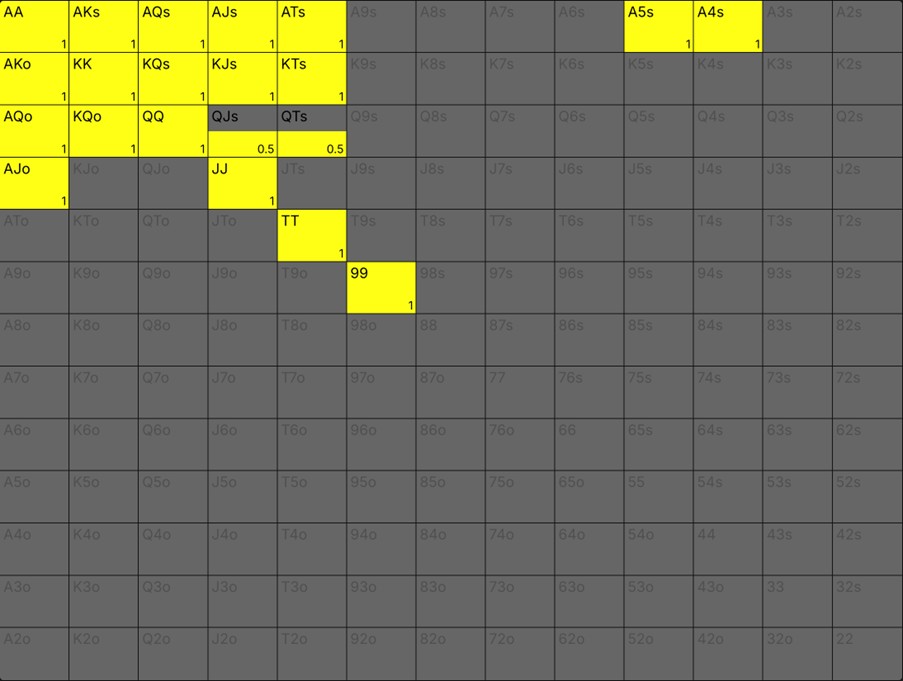
If we used the above squeeze range in every scenario in all poker games, we’d likely be doing fine. We can then practice modifying our approach based on the exact formation and opponents.
The shortcomings of the above starting template are as follows -
- Solver squeezing ranges typically have a few more semi-bluffs and also dig slightly deeper into the pocket pair region.
- The template is technically too tight for later formations (but it’s still ok as a starting point).
Early Position Solver Squeeze
Imagine the following scenario -
- LJ open raises to 2.5bb
- HJ cold calls 2.5bb
- CO?
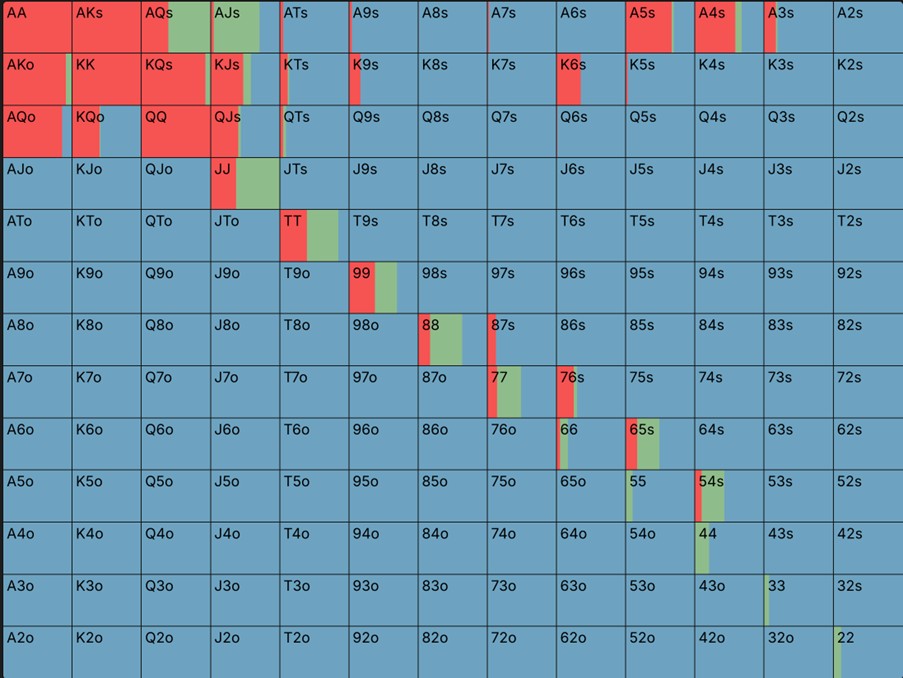
KQo, and AJo are technically borderline according to solver. However, the solver sometimes squeezes 66-88 and some suited connectors.
It's crucial to keep in mind that the solver output is not an accurate GTO poker solve here.
The solver will have employed significant simplification techniques to estimate the postflop EVs of various hands in multiway pots.
The suggestion to squeeze K6s certainly seems ‘off’ from a human perspective, and there is zero guarantee that the suited connectors will be profitable in practice.
Our starting poker hand template is safer and more reliable than a solver range.
Late Position Solver Squeeze
Now imagine the following scenario -
- CO 2.5bb open raise
- BTN calls 2.5bb
- SB folds
- BB?
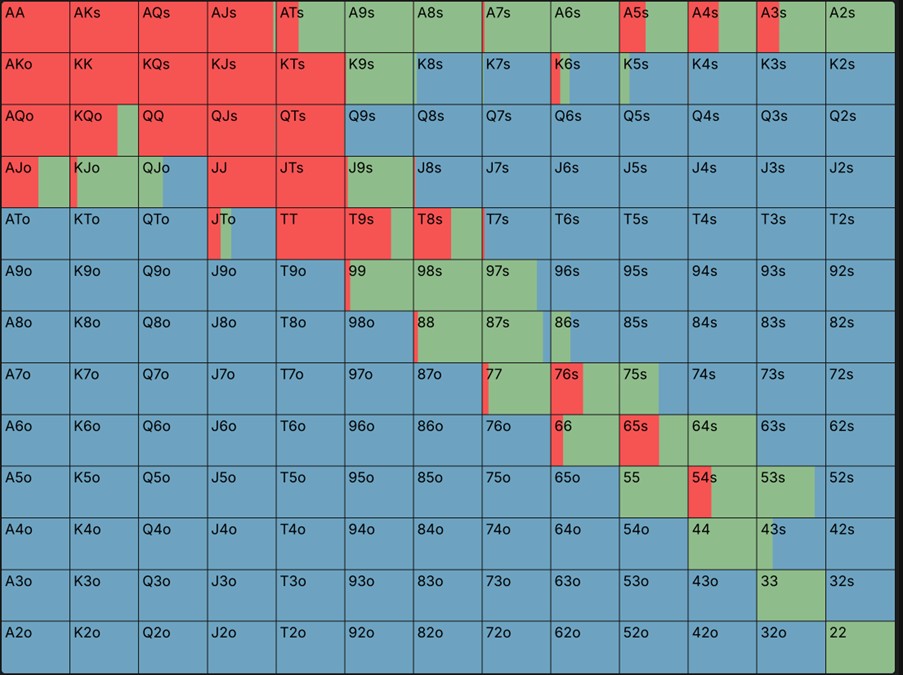
Although solver squeezing range is clearly looser here, the change is not dramatic. In other words, the same types of hands make sense as squeezes, regardless of the formations involved.
It’s easy to see why we can use a singular squeezing template and lean more towards looseness/tightness depending on the formation.
A more significant change occurs when the initial cold caller is the SB.
BB is supposed to have quite a few more semi-bluff squeezes (including Kxs and Qxs type squeezes) when the SB is involved.
However, the core of the squeezing range remains very similar to the template.
Key Takeaway
Rather than struggling to learn a squeezing strategy for every formation, we can refer to the core squeezing template like a poker cheat sheet.
We can then tighten/loosen the approach based on the precise action.
Squeeze strategy can go a long way to upping your winrate but we can also use cold preflop 3bet strategy to finetune our skill level.
