



3betting aggressively from the blinds will be an essential part of our poker strategy, particularly against late-position opens.
Many players, when learning how to play poker, 3bet aggressively from the blinds. However, these same players struggle with the best play when facing a 4bet.
In this article, we’ll discuss strategies for dealing with a 4bet after 3betting from the blinds against a BTN open.
SB Defence vs BB Defence Frequencies
Most players assume that the strategy from both blinds will be almost identical, but this assumption is not strictly valid.
- As a quick recap, SB’s 3betting range is more linear than the BB’s.
- BB’s 3bet range contains more semi-bluffs and subsequently allows folding slightly more often when facing a BTN 4bet.
Let’s imagine the following action -
- BTN open raises to 2.5bb
- SB or BB 3bets to 11bb
- BTN 4bets to 22bb
| SB Defence (Solver) Fold 26.1% Call 51.1% Raise 22.8% | BB Defence (Solver) Fold 30.9% Call 45.6% Raise 23.5% |
Note that the folding frequencies are very low, although this result is partly because of the small 4bet sizing.
The BB folds more often than the SB in GTO poker theory: 30.9% folds vs 26.1% folds.
In practice, many human players fold more often from the SB when facing a 4bet. Poker training usually encourages players to play ‘3bet or fold’ from the SB, potentially leaving the 3betting range uncomfortably wide.
In contrast, most humans are passive with BB 3bets, ironically making it easier to continue when facing a 4bet.
Defending Ranges vs 4bet
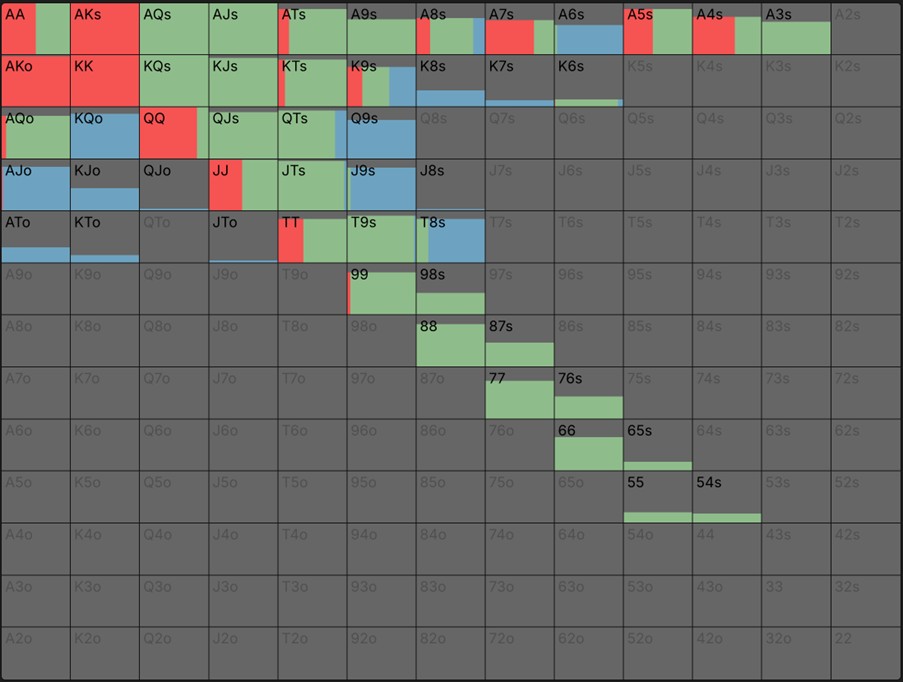
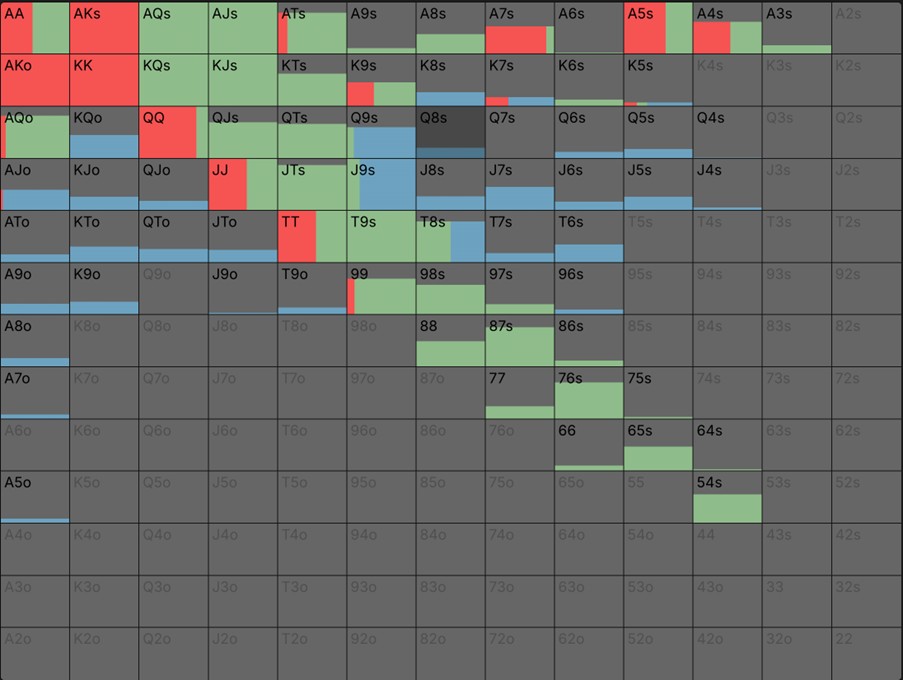
Once we face the 4bet, both positions share similarities in how to continue. Here are two simple poker cheat sheet hand range charts to get you started:
Jamming Range:
Both positions 5bet TT+ and AK for value. TT-QQ and AA sometimes flat the 4bet to help protect the calling range. Both positions also jam a selection of Axs as semi-bluffs and even some Kxs, with low frequency.
Flatting Range:
Suited connectors and suited broadways should nearly always flat call against the 4bet. Flatting with suited connectors won’t be particularly profitable, but doing so helps to prevent us from folding too frequently to the BTN 4bet.
Folding Range:
Off-suit broadways below AQo are generally unattractive as defends and make standard folds, including KQo and AJo. Suited high cards below K8s almost always fold, though some Kxs hands are exceptions.
Despite being out of position with a low SRP (stack-to-pot ratio), it's still more crucial to have a hand with playability than one with raw equity.
Therefore, a poker hand like 78s always defends while a hand like KQo always folds.
Adjustments to a Default Strategy
- https://www.888poker.com/magazine/improve-iso-raising-poker-strategyIf our opponent uses a larger 4bet sizing, we can begin to fold weaker hands, such as suited connectors.
- The defending range relies on our opponent having 4bet semi-bluffs such as Axs, Kxs, off-suit broadways, and suited connectors. If the 4bet range is tighter than this, we’ll need to fold more often preflop.
- The 5bet semi-bluff strategy (e.g., Axs) focuses on our opponent folding just under 50% of the time to a 5bet. Since many opponents fold closer to 35%, 5bet jamming as a semi-bluff could be less applicable by default.
Counteracting 4bets is a useful skill, however, using iso raising to increase winrates and profits is even more crucial.
