

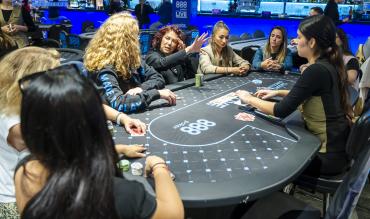

Women represent approximately 4% of the global poker player pool. That number has grown steadily since the early 2000s, driven by online poker's accessibility, increased visibility of female players at major poker tournaments, and a broader cultural shift in who the game is for. Women compete at every level of poker today, from recreational home games to WSOP Main Events, and the barriers that remain are social and psychological, not related to ability.
Women in Poker: A Brief History
Women have competed in organised poker since the earliest World Series of Poker events. Barbara Enright and Terry King were among the first female regulars at the WSOP, competing in an environment that was, by most accounts, unwelcoming to women.
The poker boom of the early 2000s marked the first major shift. Online poker removed the casino as a barrier to entry, allowing women to learn, practise, and improve without navigating the social dynamics of live card rooms. Female players like Xuan Liu built professional-level games entirely online. Simultaneously, televised poker brought women into mainstream visibility: Jennifer Harman, Vanessa Rousso, Annie Duke, and Jennifer Tilly appeared regularly on High Stakes Poker and similar programmes.
The clearest single turning point came at the 2007 WSOPE in London. Annette Obrestad, an 18-year-old Norwegian player who had developed her game entirely online, won the Main Event, defeating a field of established professionals to claim £1 million. She became the youngest WSOP Main Event champion in history. Her win demonstrated that online poker had created a genuine pathway for women to reach the top of the game.
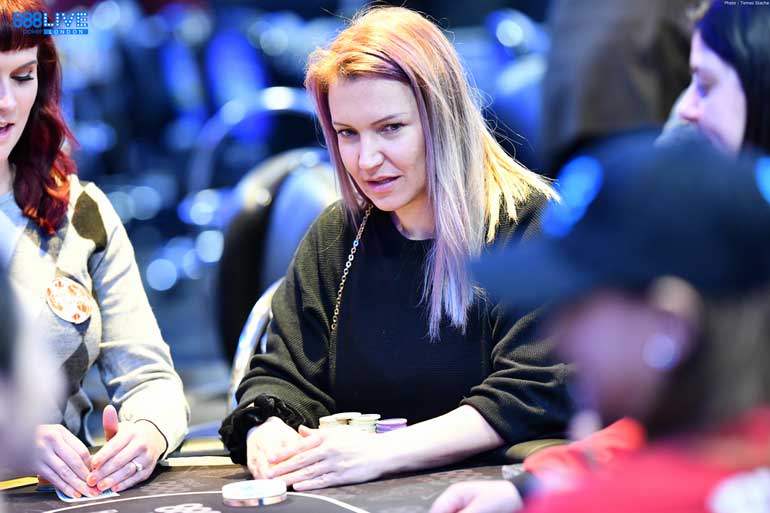
Since 2007, women have continued to make inroads at the highest levels of the game:
- Vanessa Selbst reached world number one in the global rankings across all genders.
- Victoria Coren-Mitchell became the first person, male or female, to win two EPT Main Events.
- The average age of women cashing at the WSOP has fallen consistently, reflecting a younger and deeper female player pool.
The gender gap remains significant, but the direction of travel is clear.
The Gender Gap in Poker Today
Women make up roughly 4% of the global poker player pool and between 3-6% of WSOP Main Event fields, even in events designed to attract recreational players. This is not a reflection of ability. It reflects a set of barriers – social, environmental, and psychological – that make poker feel less accessible to women than it actually is.
The most significant barriers are:
- Environment. Live poker rooms are male-dominated spaces. The social dynamics – unsolicited commentary, condescension, being visibly out of place – create friction that male players simply don't encounter.
- Underestimation. Female players are routinely underestimated at the table. Experienced players learn to use this as an edge. For newer players, the experience is more often discouraging than advantageous.
- Marketing. Poker advertising has historically targeted men, not as deliberate exclusion but as a function of the existing customer base. The effect is the same either way: the game presents itself as not being for women.
Sofia Lovgren has observed in an interview: "Men always underestimate girls when it comes to playing poker. And if you're smart enough to overcome that prejudice, you can surely turn it into a profit."
What It's Like to Be a Woman at the Poker Table
Female poker players occupy a specific position at the table: they are consistently identified as women first and players second. Every decision – a call, a raise, a bluff – is filtered through that label by opponents. The result is a form of hyper-visibility that male players don't experience.
This dynamic has two direct consequences:
- Increased scrutiny. Female players are watched more closely, questioned more often, and held to a different social standard than male players at the same table.
- A structural edge. Opponents who assume a female player is passive, cautious, or inexperienced are giving away information. In a game built on deception, being underestimated is a genuine strategic advantage.
The overall experience for women who stay in the game tends toward the positive. The discomfort of the environment is real. So is the agency that comes from succeeding in it on your own terms.
Why Women Should Play Poker
Poker offers women three specific benefits that are difficult to replicate in other environments: a structured framework for practising aggression, direct training in financial decision-making, and a competitive space where gender is irrelevant to outcomes.
Poker Trains Aggression
Winning poker requires aggression. This is a structural requirement of the game. Players who bet and raise at the correct frequencies consistently outperform passive players. There is no successful long-term strategy built on caution.
For many women, this is where the game becomes most challenging, not strategically, but psychologically. Amanda Botfeld, author of A Girl's Guide to Poker and Poker Power instructor, documented a consistent pattern across hundreds of female students: teenage girls played fearlessly, bluffing freely and applying pressure without hesitation. Adult women, including senior executives and business owners, routinely struggled to do the same.
"Something had clearly happened to these women between ages 15 and 45," Botfeld writes. "They went from playing to win to playing not to lose."
Poker makes the cost of passivity immediate and quantifiable. You either develop an aggressive approach or you lose chips. That direct feedback loop is what makes poker an unusually effective environment for practising assertiveness.
Poker Builds Financial Intuition
Most financial education focuses on restriction: spend less, save more. Poker teaches capital deployment: how to think about generating, protecting, and maximising returns from a position of strength.
The specific concepts poker reinforces:
- Expected value. Every decision has a calculable long-term return. Good decisions produce positive EV; bad decisions produce negative EV, regardless of short-term outcomes.
- Margin thinking. Winning small pots is insufficient. Your wins must be large enough to absorb your losses. Maximising value from strong holdings is not optional.
- Capital allocation. Deep-stack tournament play trains the skill of deploying resources from a position of strength rather than making decisions under scarcity.
The principle is direct: society teaches women to approach finances from a place of scarcity. Poker teaches them to approach finances from a place of power.
Poker Creates a Level Playing Field
When you put chips in the middle, what matters is the bet, and not who made it. Poker is one of the few competitive environments where professional title, social status, and gender are genuinely irrelevant to the outcome of any given hand. The chips don't know who you are.
For women who have experienced being consistently underestimated or talked over in professional environments, this is a meaningful distinction. At the table, decisions speak louder than identity.
Notable Women in Poker
The following female players have achieved results that place them among the best in the game regardless of gender.
Kristen Foxen
Foxen is the highest-earning woman in live poker history, with over $15 million in recorded tournament earnings. A Canadian professional who began grinding online in 2006, she built her live reputation through sustained consistency. She is a five-time WSOP bracelet winner, a four-time GPI Female Player of the Year (2017, 2018, 2019, 2023), and ranks among the top 120 all-time earners across all genders.
Vanessa Selbst
Selbst was the highest-earning female player in live tournament history until Kristen Foxen surpassed her in 2025. A three-time WSOP bracelet winner, her technically aggressive style demonstrated that the highest level of the game is fully accessible to women.
Annette Obrestad
Obrestad won the 2007 WSOPE Main Event at 18, becoming the youngest champion in WSOP history. She built her game entirely online, developing one of the most technically complete playing styles of her generation before she was old enough to enter a casino in most jurisdictions.
Victoria Coren-Mitchell
Coren-Mitchell was the first player, male or female, to win two European Poker Tour Main Events, having won in 2006 and 2014. A writer and broadcaster as well as a poker player, she is one of the most prominent public faces of the game in the UK.
Liv Boeree
Boeree accumulated close to $7 million in live tournament earnings and held the position of world's top-ranked female player from 2014 to 2016. She holds a degree in astrophysics and co-founded Raising for Effective Giving alongside Igor Kurganov. She mostly retired from poker in 2018 having only a few appearances since then, including her biggest prize ever ($2.8M) after finishing 4th in the 2025 WSOP Paradise Main Event.
Jennifer Tilly
Tilly has more than $1 million in live tournament earnings, including multiple first-place finishes. An Academy Award-nominated actress, she is known for using a deliberately playful persona to obscure her technical ability – a strategy that has proven consistently effective.
Maria Ho
Maria Ho is a tournament player with millions in live earnings, a prominent poker broadcaster, and one of the most visible advocates for women in the game. She was inducted into the Women in Poker Hall of Fame in 2018.
The Women in Poker Hall of Fame
The Women in Poker Hall of Fame (WiPHoF) is the leading institution dedicated to recognising women who have made a lasting impact on poker. It was established in 2008.
Eligibility requires candidates to be at least 35 years old and to have spent a minimum of 10 years influencing poker as players, executives, media figures, or community builders. The Hall of Fame honours contributions across all dimensions of the game: competitive achievement, industry leadership, media work, and advocacy.
Selected inductees by year:
- 2008: Barbara Enright, Linda Johnson, Marsha Waggoner, Susie Isaacs
- 2009: Jan Fisher, Cyndy Violette, June Field
- 2010: Kathy Liebert, Billie Brown, Jennifer Harman
- 2011: Margie Heintz, Kristy Gazes Green, Phyllis Caro Yazbek
- 2012: Kathy Raymond, Joanne "JJ" Liu
- 2014: Allyn Jaffrey Shulman, Deborah Giardina
- 2016: Debbie Burkhead, Victoria Coren Mitchell
- 2018: Maria Ho, Lupe Soto
- 2022: Jennifer Tilly, Vanessa Selbst, Angelica Hael, Terry King
- 2024: Kristen Foxen, Jeanne David
- 2024 Pioneer: Starla Brodie
The WiPHoF makes visible the full range of contributions women have made to poker. A history that is easy to overlook in a sport whose mainstream narrative has been largely written by and about men.
Ladies' Events in Poker
Women-only poker tournaments, commonly called Ladies' Events, have been part of the WSOP since 1977. They exist across live and online poker in various formats and remain a regular fixture of the annual circuit.
Their purpose is specific: to reduce the psychological and social barriers that prevent women – particularly newer players – from competing in live tournaments. An all-female field removes the most common sources of friction: the social dynamics of male-dominated rooms, the unsolicited commentary, the experience of being visibly out of place.
For some women, a Ladies' Event is the only live tournament they'll enter. Getting someone to the table once is how you get them to come back.
The WSOP structures its Ladies' Event as a $10,000 buy-in with a $9,000 discount for women. Men can legally enter at the full price. The few who do add prize money to the pool but miss the point: these events exist to create an environment where women who wouldn't otherwise play in a live field will do so. The value is not financial.
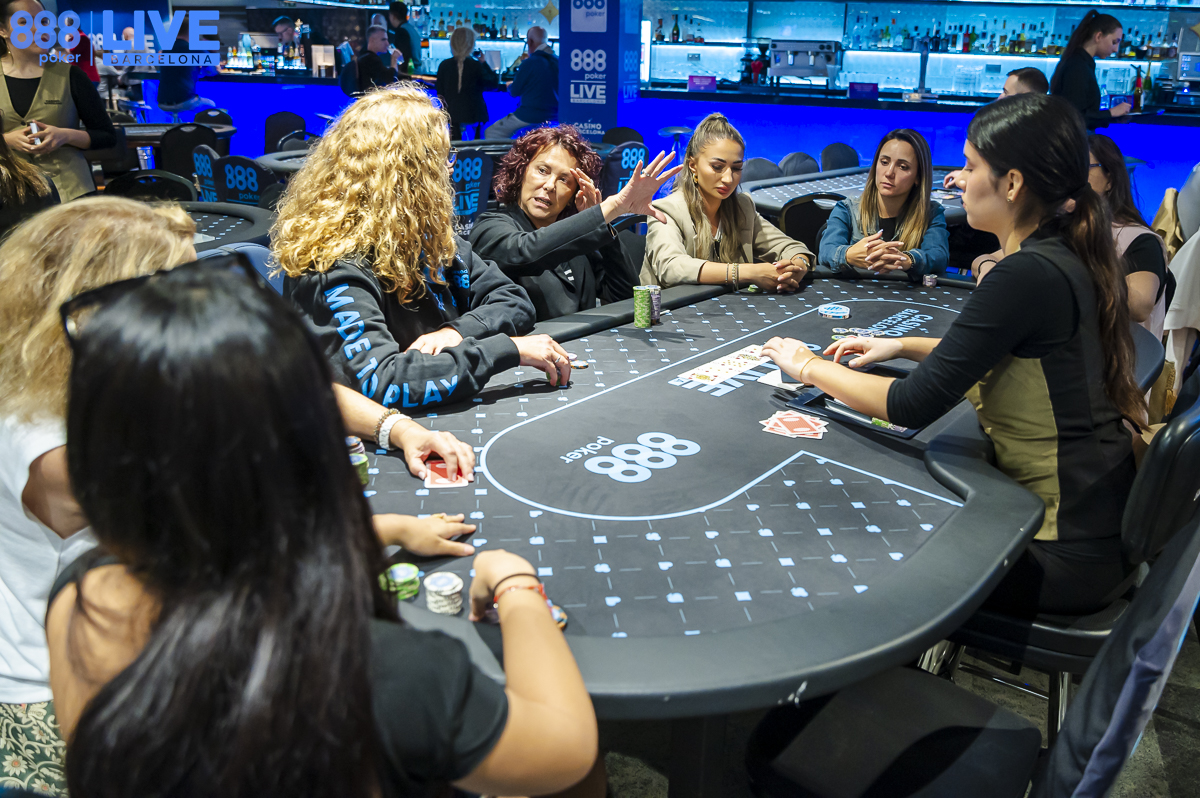
The 888.com Women's Poker Open is the largest poker event exclusively for female players and has been televised as part of its history. Ladies' Events consistently demonstrate that demand exists when the environment is right.
FAQ - Women in Poker
What percentage of poker players are women?
Women make up approximately 4% of the global poker player pool. At the WSOP Main Event, female participation has historically ranged between 3% and 6% of the field, including in events designed to attract recreational players.
Can women beat men at poker?
Yes. Poker is a skill game in which gender provides no structural advantage to either side. The game's outcomes are determined by decision-making, not physical attributes.
Why are there so few women in poker?
The barriers to female participation are social and environmental rather than ability-related. Live poker rooms have historically been male-dominated environments with social dynamics that can be unwelcoming to women, particularly newer players. Poker marketing has also targeted men as its primary audience, which shapes perceptions of who the game is for.
What is the Women in Poker Hall of Fame?
The Women in Poker Hall of Fame (WiPHoF) is an institution established in 2008 to recognise women who have made a lasting contribution to poker as players, executives, media figures, or community builders. Nominees must be at least 35 years old with a minimum of 10 years of influence in the game.
What are Ladies' Events in poker?
Ladies' Events are women-only poker tournaments. They exist to lower the barrier to live poker entry for women who would not otherwise compete in mixed-gender fields. The WSOP has run a Ladies' Event since 1977. The 888.com Women's Poker Open is the largest dedicated female poker event in the world.
Is poker good for women?
Poker offers women a structured environment for practising aggression, risk tolerance, and financial decision-making – skills with direct real-world application. The game rewards assertive play, penalises passivity, and produces immediate, honest feedback on decisions. Many women who play regularly describe it as one of the few competitive environments where gender is genuinely irrelevant to outcomes.
Key Takeaways
- Women make up approximately 4% of the global poker player pool, a number that has grown steadily since the early 2000s.
- The barriers to female participation are social and psychological, not related to ability. Women compete successfully at every level of the game.
- Poker trains aggression, builds financial intuition, and creates a competitive environment where gender is irrelevant to outcomes.
- Kristen Foxem, Vanessa Selbst, Annette Obrestad, Victoria Coren-Mitchell, Liv Boeree, and Maria Ho are among the most accomplished female players in the game's history.
- The Women in Poker Hall of Fame has recognised outstanding contributions to poker by women since 2008.
- Ladies' Events serve a specific function: lowering the barrier to live tournament entry for women who would not otherwise compete in mixed-gender fields.
- Being underestimated at the table is a genuine strategic edge that experienced female players use deliberately.
