



Poker is a game of skill. In the short term, luck plays a significant role, but over a large enough sample of hands, skill is the dominant factor. Academic research, large-scale hand analysis, and the existence of consistent long-term winners all confirm this.
Here's what the evidence shows.
How Do We Know Poker Is a Skill Game?
A reliable test for skill in any game: can you intentionally lose? In roulette, no – no matter what you do, there's always a chance the ball lands in your favour. In poker, yes – fold every hand preflop and you're guaranteed to lose. Your decisions have direct consequences on your results. That's the definition of a skill element.
Poker also has a structural difference from casino games: you don't play against the house. The casino takes a small rake from each pot regardless of outcome. Your opponents are other players, and beating them consistently over time requires skill, not luck.
How Does Poker Compare to Roulette and the Lottery?
In roulette, mathematical calculations prove it's impossible to gain an edge. No strategy changes the house edge over time. In the lottery, a single win proves nothing – play every day and you'll lose consistently. Neither game can be beaten.
Poker is different. Decisions affect outcomes. Edges are real. The game can be beaten, and consistently beaten by the same players, over millions of hands.
Did Modern Technology Prove Poker Is a Skill Game?
Poker solvers are computer programs that calculate the optimal play for any poker situation. They are to poker what chess engines are to chess – and like chess engines, their existence proves that a correct, learnable strategy exists.
No equivalent software exists for slot machines, craps, or roulette. You can't solve a game that has no optimal strategy.
The evolution of poker reflects this. Doyle Brunson, the Godfather of Poker, built a career on instinct and reads. "Show me your eyes, and you may as well show me your cards," he said. Doug Polk, one of the most influential players of the modern era, took the opposite approach: "I never go with my instincts." Polk used solvers and random number generators, converting poker into a mathematically defined game.
Both won consistently. The methods changed, but the skill requirement didn't.
At What Point Does Skill Overtake Luck in Poker?
In a single hand, a complete beginner's chances against a world-class professional are close to 50/50 – cards are random and luck dominates at small samples. Play 100 hands, 1,000 hands, 10,000 hands, and the professional wins almost every time. Volume erases luck.
The statistical tipping point where skill eclipses luck is approximately 1,471 hands, around 16 hours of online poker at a single table, or 19-25 hours of live play. Beyond this threshold, sustained winning requires genuine ability. A beginner rarely survives a full day of play.
However, 1,471 hands is not the same as a reliable sample size. Below 10,000 hands, results tell you very little about your actual win rate. A player can run well for 50,000 hands and still be a long-term loser. The tipping point and the proof point are two different thresholds.
Why do Good Poker Players Still Lose? The Role of Variance
Variance is the statistical swing between actual results and expected results over a given sample. In poker, variance is large – much larger than most players expect.
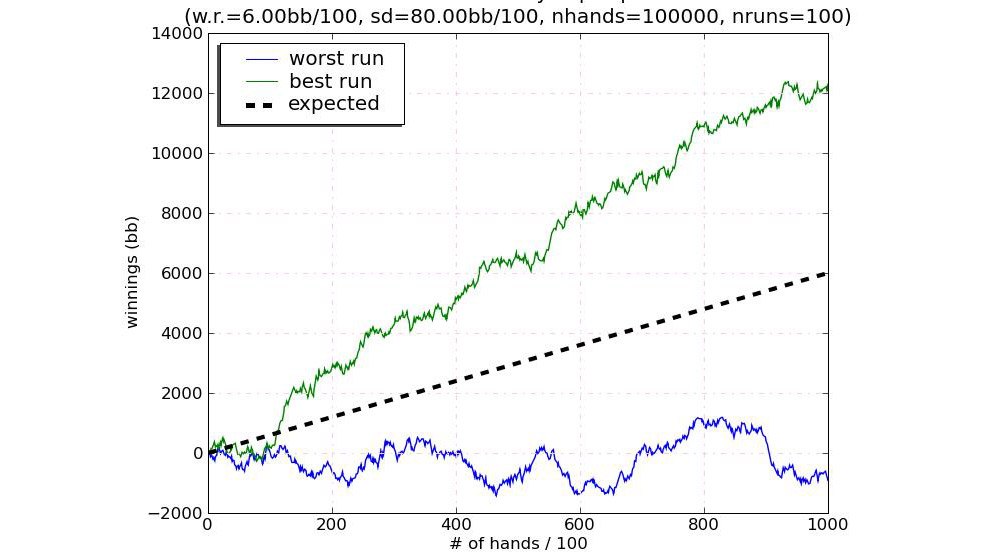
A proven winning player at 6 big blinds per 100 hands can still show a net loss over 100,000 hands during a bad run. The EV simulator below shows the range of possible outcomes for exactly this player across 100 simulations. The spread between best and worst case is significant even at that sample size:
Variance is even more pronounced in tournaments than in cash games. Live tournament players who compete in a limited number of events per year may never accumulate enough hands for results to accurately reflect their skill level, even over a lifetime of play.
Short-term results are not reliable evidence of skill or lack of it. Only large samples are.
What Does the Research Say?
A 2015 academic paper, Beyond Chance? The Persistence of Performance in Online Poker, analysed player results over time and found:
- Players in the top 10% in the first half of a year were more than twice as likely to repeat that performance in the second half.
- Players finishing in the top 1% were 12 times more likely to do so again.
- Players who performed poorly early continued to lose.
If poker were a game of pure luck, consistent repetition of results, good or bad, would be impossible.
A separate study by Citigal, Inc. analysed 103 million online poker hands and found that 75% of hands never reached showdown, and only 12% of hands were won by the player holding the best cards. The study concluded that Texas Hold'em is 88% skill.
The existence of professional poker players (people who earn their primary income from the game over many years) is itself evidence. Sustained results at that level are not compatible with a game of pure chance.
Key Takeaways
- Texas Hold'em is estimated at 88% skill, based on analysis of 103 million hands.
- Poker can be intentionally lost proving decisions directly affect outcomes, unlike pure gambling games.
- In poker, you compete against other players, not the house. Edges are real and exploitable.
- Skill eclipses luck at approximately 1,471 hands; below 10,000 hands, results are not a reliable measure of ability.
- Variance is large enough that even strong winning players can show losses over tens of thousands of hands.
- Academic research confirms that top performers repeat their results at rates impossible to explain by chance alone.
