

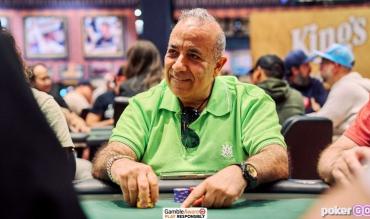

Image courtesy of PokerGO.com: WSOP 2023 Event #25 – Sam Farha
Sam Farha spent roughly 15 years as one of the most feared high-stakes cash-game players in the world before most people outside poker circles knew his name. His runner-up finish at the 2003 World Series of Poker Main Event changed that, turning him into one of poker's most recognisable faces. What it didn't change was where he made his money: primarily in Pot-Limit Omaha cash games whose results have never been publicly tracked.
All figures attributed to Farha's net worth are estimates based on publicly available information.
Who Is Sam Farha?
Ihsan "Sam" Farha was born in Beirut, Lebanon, in 1959. When the Lebanese Civil War broke out in 1975, his family relocated to the United States. He graduated from the University of Kansas with a degree in Business Administration, settled in Houston, Texas, and discovered poker in the late 1980s. By 1990, he had turned professional.
What makes Farha unusual among players of his generation is the shape of his tournament record. He entered his first WSOP in 1996 and won a bracelet that same year in the $2,500 Pot-Limit Omaha event.
Over the following 14 years, he added two more, all in Omaha formats: Omaha Hi-Lo in 2006 (defeating Phil Ivey heads-up) and the $10,000 Omaha Hi-Lo Championship in 2010. Three bracelets, three different Omaha disciplines, across a 14-year span.
Between those results, tournaments were largely incidental. His primary arena was the highest-stakes cash games he could find, and his reputation there predated his television profile by years. He has continued to cash at the WSOP into his mid-60s, most recently in 2025.
Sam Farha Net Worth (Estimated)
Published estimates of Sam Farha's net worth cluster around $100 million, with some outlets pushing as high as $120 million. None of those figures comes with a disclosed methodology.
His recorded live tournament earnings, per the Hendon Mob, stand at approximately $3 million – a figure that accounts for a fraction of the $100 million estimate. The gap is attributed almost entirely to decades of high-stakes PLO cash game activity, which no public database has ever tracked.
That inference is plausible. Farha played regularly in some of the biggest cash games in Las Vegas for decades. Six-figure session swings have been reported by some of the greatest poker players of all time who shared those tables. But plausiblibility is not verified.
No personal financial statements, tax disclosures, or court records provide a reliable anchor. A range is the honest framing: most estimates place him in the tens of millions, but anyone citing a precise figure is working from inference rather than documentation.
Sam Farha Tournament Winnings Breakdown
Legendary high stakes player Sammy Farha has three #WSOP bracelets each in an Omaha variant #poker pic.twitter.com/ta36MlM0d4
— WSOPMemories (@WSOPMemories) July 6, 2016
According to the Hendon Mob, Sam Farha's recorded live tournament earnings total $2,996,618 across 42 cashes. For a career spanning nearly three decades, that’s a deliberately sparse footprint.
He played tournaments selectively, and the cash games were always the primary business.
His five largest recorded results:
- WSOP Main Event, 2003 – $1,300,000 (2nd place)
- WSOP $10,000 Omaha Hi-Lo Championship, 2010 – $488,241 (1st place)
- WSOP $5,000 Omaha Hi-Lo, 2006 – $398,560 (1st place)
- WSOP $2,500 Pot-Limit Omaha, 1996 – $145,000 (1st place)
- NBC National Heads-Up Championship, 2009 – $125,000 (3rd place)
The 2003 Main Event result accounts for roughly 43% of his career total – a notable concentration, and all the more striking because his biggest recorded cash came in Texas Hold'em, not Omaha.
These are gross prize figures. Each came with buy-in costs and applicable tax withholding before anything reached his pocket. The three bracelet wins alone carried combined entry fees of $17,500.
What the database records is a competitive result; what Farha retained from each one is an entirely separate calculation.
Other Income: Sponsorships, Media, and Professional Activity
During poker's boom era, Farha accumulated a profile that extended well beyond tournament prize money.
- He served as a spokesman for Harrah's casino in Las Vegas, appeared across all four seasons of High Stakes Poker on GSN (2006-2007), and made a cameo as himself in the 2007 film Lucky You.
- He also appeared on Poker After Dark during that period. None of the financial terms associated with these arrangements has been made public.
In 2007, he co-authored Farha on Omaha: Expert Strategy for Beating Cash Games and Tournaments with Storms Reback. The book remains in circulation, and royalty figures are not disclosed.
A second book and a reality TV project were announced but have not been confirmed as completed. No active sponsorship deals have been publicly confirmed since the boom era ended.
Public Profile, Lifestyle, and Privacy
Farha said in an interview in the early 2010s that he had grown tired of playing high-stakes poker after roughly 15 years and preferred to find good Omaha games closer to home. It was a candid statement about his competitive appetite and about as much as he has ever offered publicly about his professional circumstances.
On financial matters, he has said nothing. He is married, based in Houston, and keeps his personal life private.
FAQ – Sam Farha Net Worth
Is Sam Farha a millionaire?
Based on three WSOP bracelets, decades in some of the largest cash games in Las Vegas, and documented commercial work during the boom era, accumulated wealth well into the millions is a reasonable conclusion. No confirmed figure has been made public.
What is Sam Farha best known for in poker?
Casual audiences know him as the runner-up to Chris Moneymaker in the 2003 WSOP Main Event. Among poker players, he is regarded as one of the finest PLO cash game specialists of his generation – a reputation built years before that appearance.
Do tournament winnings equal net worth?
No. Prize money is a gross figure before buy-in costs, taxes, and staking arrangements. The gap between Farha's $3 million in tracked earnings and the $100 million figure in circulation is among the largest in this series, hinging almost entirely on assumptions about untracked cash-game results.
Does Sam Farha earn income outside of poker tournaments?
During the boom era, he served as a casino spokesperson, appeared on four seasons of High Stakes Poker, co-authored a strategy book, and had a cameo in a film. Terms for none of these were disclosed. No post-boom commercial deals have been publicly confirmed.
Why are net worth estimates for poker players often given as ranges?
Because tournament prize money is the only income that enters the public record, it rarely tells the full story. For Farha, the circulating estimates rest almost entirely on inferences about decades of cash-game activity that was never reported anywhere.
