



Preflop overcalling is a blind spot for many poker players. It’s also an excellent opportunity for significant winrate gains if we're among the few who understand what’s happening.
To be clear, overcalling refers to calling after another player has already cold-called.
By overcalling, we are, therefore, creating a multiway pot.
Why Overcalling is a Blind Spot
To understand why overcalling is a blind spot, consider some solver output for the following Texas Holdem scenario.
- CO open raises to 2.5bb
- BTN calls
- SB calls
- BB?
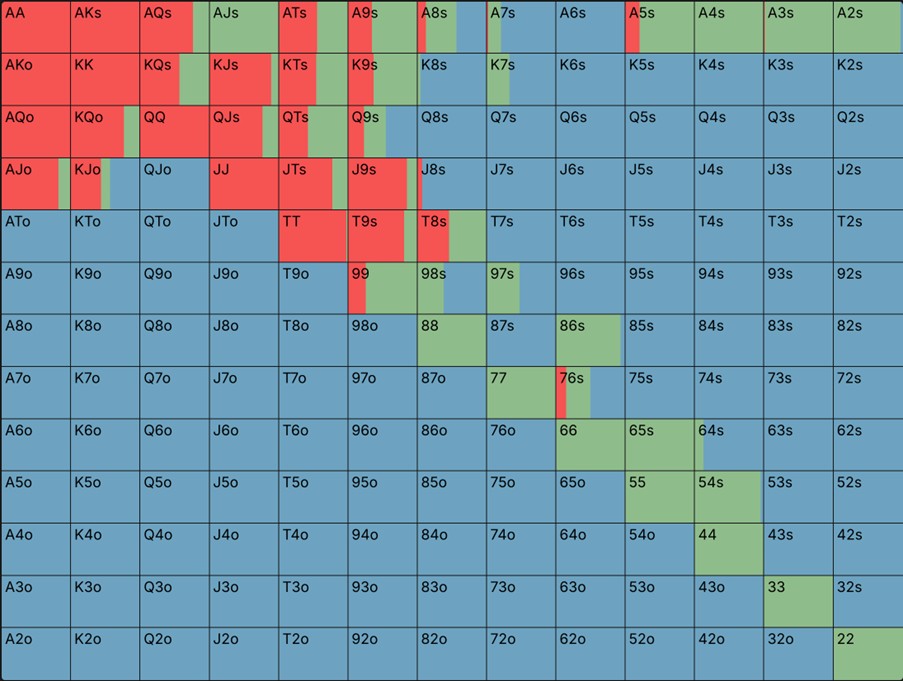
Take a moment to think about what you would defend in practice.
Does anything seem unusual about the solver output?
We are closing the action and getting an excellent price on the call. Folding Axs, suited connectors and suited gappers seem insane.
Not only should we defend these hands, but we could easily imagine defending quite a bit wider than these holdings.
The Problems with the ‘Solve’
The solver output is not necessarily a good representation of GTO poker play. Many players don’t stop to think about this.
We are solving a 4-way postflop game tree to arrive at a preflop solution. However, 4-way solves are generally computationally impossible due to massive time and storage constraints.

So, if 4-way solving doesn’t yet exist, what exactly is the solver showing us?
Clearly, it’s doing something to arrive at a preflop range.
The solver will base its calculation upon a heavily simplified 4-way postflop tree.
The exact simplification algorithm is not even known in this case – but calling the output ‘GTO’ could be misleading.
Given the disconnect between what the solver defends and what we feel the solver should defend, we can infer that the simplification algorithm is not very realistic.
How to Construct Overcalling Ranges
Ok, so we clearly can’t rely on the solver to construct overcalling ranges. We’ll need to handcraft these based on our intuition, including for 3-way spots.
Besides, even if we had a perfect GTO solve for a multiway preflop scenario in any poker hand, there is still a glaring issue.
Solver assumes our opponents are playing perfect GTO poker in multiway postflop pots.
This assumption is not even close to being true. Almost all humans play significantly worse in multiway pots compared to heads-up pots!
In other words, even with the perfect solve, we should overcall wider than solver, with the intention of capitalising on opponent mistakes.
At a minimum, in this scenario, we should probably defend the following -
- All suited Ax and Kx
- All suited connectors, gappers and two-gappers
- All off-suit broadways
Whether we go even wider or tighten up slightly will depend on the opponents. Assuming we are not in the BB, we’ll also have to consider the tendencies of the players behind when deciding whether to defend.
Overcalling in Other Scenarios
There are too many situations to create an exhaustive list of preflop strategies. Realistically, poker probability dictates making many overcalling decisions on the fly.
A general tendency to push things wider than solver should be very good for our winrate.
Precise GTO strategies aren't yet calculable, but it shouldn't stop us from making a solid estimate based on our intuition as poker players.
Now, we've got to grips with overcalling, let's explore Basic Squeeze Poker Strategies.
