



Online poker vs live poker: same game, fundamentally different experience. The pace is slower, key information isn't displayed automatically, specific rules apply only in live settings, and the social dynamics at a live table directly affect your profitability. For players transitioning from online to live poker, understanding these differences is the foundation of playing well in a live room.
This guide covers the key differences between online and live poker, from practical rules to table etiquette, so you can make the move to the live felt with confidence.
The Key Differences Between Online and Live Poker
The most important differences between online poker and live poker fall into two categories: mechanical differences (rules and information that work differently in a live setting) and social differences (how your behaviour and image affect the game). Both matter. Ignoring either will cost you.
- Mechanical differences: the one chip rule, manual pot tracking, slower pace, no HUD for stack sizes, and live tells.
- Social differences: table image, dress code, use of technology, poker lingo, and betting behaviour all signal whether you're a regular or a recreational player.
The tips below address both. Tips 1-5 cover the practical adjustments every online player needs to make. Tips 6 and 7 cover the social layer that separates good live players from great ones.
Tip 1: Learn the One Chip Rule
The one chip rule is one of the most commonly misunderstood live poker rules for players coming from online. In live poker, throwing a single chip into the pot without a verbal declaration is always ruled as a call, never a raise, regardless of the chip's denomination.
If someone raises to 400 and you throw in a single 1,000-denomination chip in silence, it's a call. To raise, you must either verbalise your intention first ("raise to 1,000") or put in the correct number of chips in a single motion. Verbal declarations are binding, so state your action clearly before your chips cross the line. The dealer will enforce this rule even if the outcome wasn't what you intended.
Tip 2: Track the Pot Size Yourself
In online poker, the software calculates and displays the pot size automatically throughout every hand. In live poker, there is no such display. Tracking the pot is entirely your responsibility.
Keep a running mental tally from the moment the first chips go in. An accurate pot count is essential for sizing your bets correctly, especially when you're targeting a specific fraction of the pot. If you lose count, you're entitled to ask the dealer to spread the pot so you can recount it – dealers are there to help, and this is a routine request.
Tip 3: Adjust to the Slower Pace
How long does a poker hand take in a live room? Longer than you're used to. Shuffling is done by hand, even in casinos with automatic shuffling machines. Also, the physical dealing and chip-handling slow things down considerably. Players take longer to act without the online clock pressure. In a typical live cash game, you'll see roughly 25-30 hands per hour – compared to 60 or more online.
The slower pace creates a specific risk: distraction. Players who check their phones, watch the TV, or drift into side conversations between hands miss reads that cost them value. Use the downtime to study your opponents – their betting patterns, physical habits, and reactions to board cards. Live poker tells are far more accessible than online reads, and building that picture costs you nothing.
Tip 4: Estimate Stack Sizes Before Every Hand
Online poker displays every player's stack size at all times. In a live room, there's no HUD, no automatic display, and no update when chips move. You're responsible for knowing how deep you and your opponents are before you play a hand.
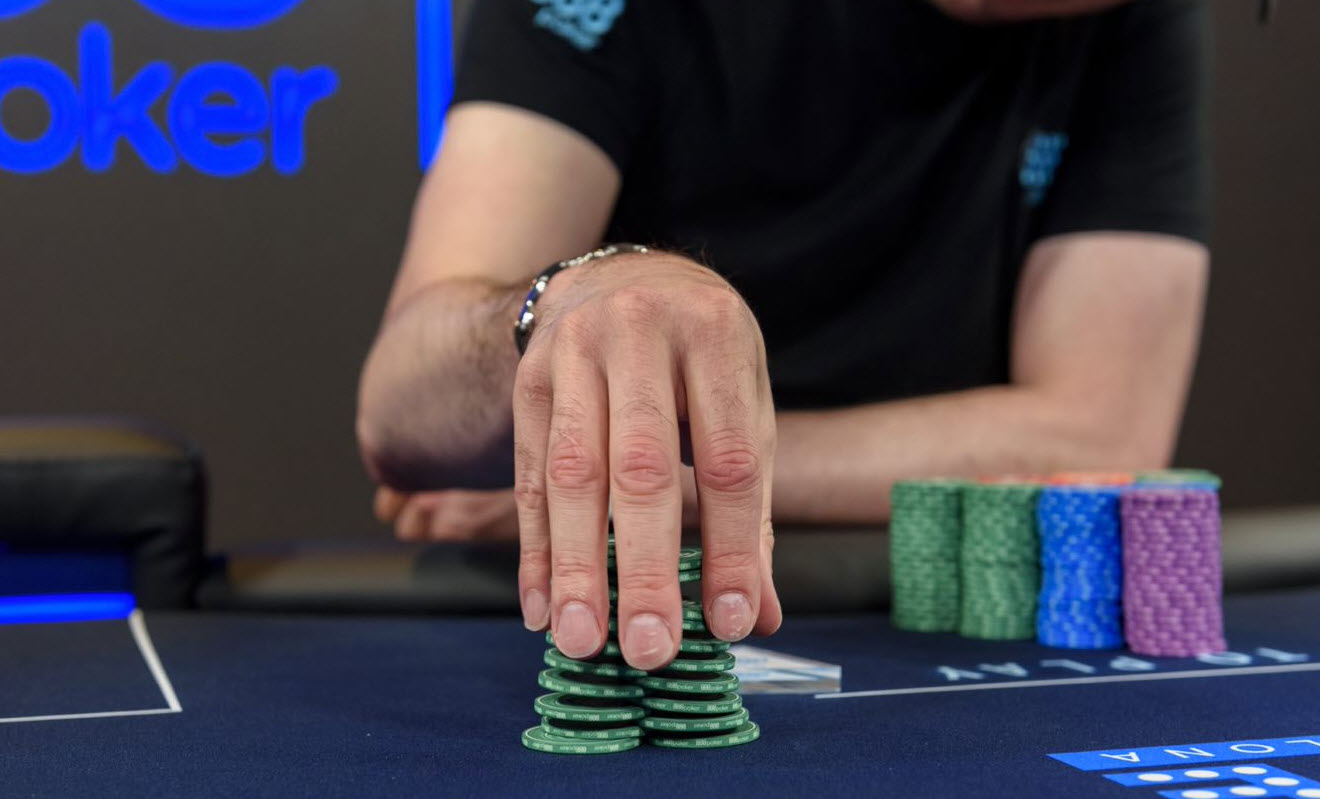
Live poker rules require chips to be stacked in easily countable piles – typically 10 or 20 chips – with the highest-denomination chips visible at the front. You're within your rights to ask an opponent to tidy a messy stack, and you can ask the dealer or floor staff to enforce this if needed. Keep your own stack neat for the same reason: it avoids delays and prevents disputes.
Chip stacking habits also reveal information about playing style. Conservative players almost always keep neat piles of 20. Creative or aggressive players tend to build uneven towers. Erratic stacks frequently mean erratic play. It's a small edge, but live poker is built on small edges.
Tip 5: Control Your Tells and Read Your Opponents'
Live tells are physical and behavioural cues that reveal information about a player's hand strength. They're one of the defining differences between live poker and online poker, and one of the biggest adjustments for players making the transition from IRL poker to a casino setting, or vice versa.
Most beginners overestimate their ability to read tells in others, and underestimate how much they're giving away themselves. The safest approach is consistency: act the same way in every hand, regardless of your holding. Put chips into the pot the same way every time. Fix your gaze on one spot on the table while waiting for opponents to act. Avoid chatting when you're active in a hand.
If every action looks identical, there's no pattern to exploit. That's the goal.
Tip 6: Manage Your Table Image (Tech, Dress, and Behaviour)
At a live cash game – whether it's a casino poker room or a home cash game – your table image affects who wants to play with you. Recreational players want to sit with other recreational players. If you project the image of a serious grinder the moment you sit down, weaker players may avoid playing pots with you, or leave your table altogether. Since the only reliable way to profit long-term at poker is to play against opponents worse than you, keeping those players comfortable is a strategic priority.
Several things immediately signal that someone is a regular:
- Headphones. Sitting down and plugging in immediately signals you're on autopilot. If you want to listen to music, use one earphone and stay available for conversation.
- The grinder uniform. Hoodie, sweatpants, and a chip pouch tell the table you spend serious time in card rooms. Recreational players dress for a night out. If you want weaker players comfortable at your table, consider dressing like one of them.
- The chip pouch. Arriving with a bag of chips signals you practically live in the casino. If you carry chips between sessions, load them into the rack before sitting down – not at the table.
- Poker jargon. Terms like "3-bet," "triple-barrel," or "nut-no-pair" signal that you've studied the game seriously and make less experienced players uncomfortable. Keep the language casual.
The principle behind all of these is the same: don't advertise your skill level. The less information your opponents have about how seriously you play, the more willing they are to play back at you.
Tip 7: Use Betting and Conversation to Control the Table
Controlling your table image goes beyond appearances. How you bet and how you interact at the table sends constant signals about the kind of player you are and directly affects whether recreational players stay or leave.
- Limp occasionally. Always raising or folding from the small blind and never limping reads as tight and kills table energy. Limping a little, especially in bomb pots, costs you little in EV and projects a looser, more recreational image.
- Be sociable. Banter is part of live poker. Smile, make conversation, crack a joke when it fits. Playing tight doesn't mean being tight-lipped. The best players at a live cash table often look like the most relaxed person in the room.
- Match the room's energy. Ordering a hot tea at a Friday night cash game signals the same thing as the chip pouch. Even if you don't drink alcohol, a non-alcoholic beer keeps your image intact.
One important caveat: all of the social tips above apply to cash games. In poker tournaments, the dynamic is different. Projecting a serious or even intimidating image can work in your favour, and you can't afford to splash chips around loosely without rebuys. The social strategy that works at a casino cash game is a different one from tournament poker.
Key Takeaways
- The main differences between online and live poker are mechanical (rules, information, pace) and social (image, behaviour, table dynamics).
- The one chip rule: a single chip thrown in without a verbal declaration is always a call. State your action before your chips cross the line.
- Track the pot manually from the first chip in. Ask the dealer to spread the pot if you lose count.
- Live poker runs at 25–30 hands per hour versus 60+ online. Use the slower pace to study opponents and build reads.
- Estimate stack sizes before every hand. Chips must be stacked visibly; you can request opponents tidy their stacks.
- Control your tells through consistent behaviour – same motion, same pace, same posture regardless of hand strength.
- Avoid grinder signals: headphones, loungewear, chip pouches, and poker jargon all tell the table you're a regular.
- At a cash game, table atmosphere drives profit – keep recreational players comfortable and they'll keep playing.
- These social adjustments are cash game-specific. Tournament poker rewards a different image.
