



3betting aggressively against the Small Blind (SB) is essential for our winrate, but can quickly become problematic if we don’t know how to defend against SB 4bets.
- We’ll need to flat 4bets wider to avoid folding too much.
- We’ll also need an appropriately wide 5betting range.
This article considers and defines an optimal defending range and discusses common mistakes made by the average poker player, especially beginners.
BB Defending Frequencies
Imagine the following scenario -
- SB open raises to 3bb
- BB 3bets to 10bb
- SB 4bets to 21bb
Since the 4bet is small, we should fold just under 40% of the time according to GTO poker theory.
- 5betting frequency ~15.9%
- Calling frequency ~ 46.3%
- Folding frequency ~37.8%
Since we have position and an excellent price on the call, we primarily defend by flatting. Assuming we defend, we flat roughly 75% of the time and 5bet jam 25% of the time. It’s almost impossible to defend at the correct frequency without using the call-vs-4bet option.
Players who arbitrarily decide to play 5bet-or-fold will have significant issues with their defending strategy.
BB Defending Range
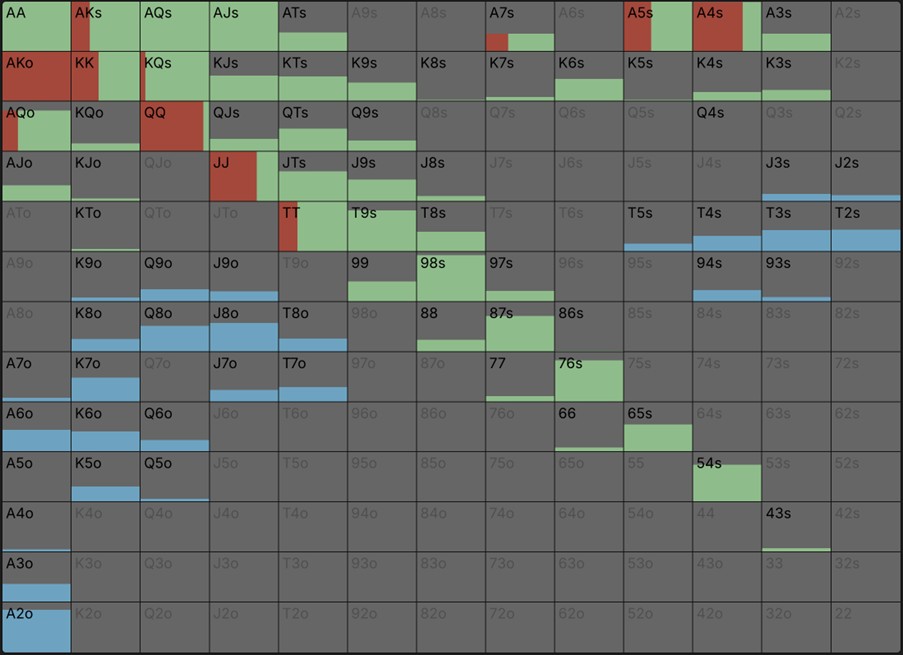
As a general guide, when we face a 4bet in the BB vs SB formation, we should avoid folding the following poker hands -
- Suited connectors/gappers
- Pocket pairs
- Suited Ax / Kx
- Suited/Off-suit broadways
In addition, we should include JJ+ and AK in our 5bet jamming range, along with the occasional TT or AQo. AKs and KK sometimes slowplay by flatting the 4bet, while AA always flats in many solver models.
This strategy leaves the following holdings in our potential Texas Holdem folding range -
- Suited high cards Jxs and lower
- Lone off-suit high cards like A7o or K5o
The Most Common Mistakes
Based on the above, let’s list some of the most common mistakes when defending against a SB 4bet:
Playing 5bet or Fold:
Since flatting is a massive component of correct defence, it’s impossible to defend well using a 5bet-or-fold approach.
Folding Speculative Hands:
It might seem natural to fold suited connectors, Axs, Kxs suited and KJo/KQo, especially since poker probability dictates that we could easily be dominated.
However, it’s good to remember that SB’s 4bet range should also contain several speculative holdings, so we can’t restrict our own defence just to premiums.
5betting Too Tight:
Risk-averse players may prefer to only jam QQ+/AK, but theory says we should be jamming TT+, AQo+, and some semi-bluffs such as A4s and A5s.
Fast Playing AA:
Aces are strong enough that they prefer to trap and potentially allow the Villain to run a postflop poker bluff. Many players automatically 5bet jam AA without ever considering the slowplay.
Adjustments to a Default Strategy
The best play in any poker situation will always consider Villain’s tendencies. Rather than blindly following theory, watch out for the following:
- If SB folds more than 52% of the time to a 5bet, we can start jamming wider as a semi-bluff.
- If SB 4bets less than 20% of the time against a BB 3bet, we can tighten up our continuing range. The SB’s 4betting range may be overly strong.
- If unsure, it’s worth remembering that the average SB player is 4betting a range that is tighter than theory would recommend.
As the size of the SB 4bet gets larger, we should fold more often and continue with stronger holdings.
Let's flip the scenario in the next article: How to Counteract 4bets While OOP in the Blinds.
