



Heads-up poker is a format in which exactly two players compete against each other for the pot. It's one of the most profitable and most demanding formats in poker, requiring significant adjustments to starting hand ranges, positional awareness, and postflop strategy.
This guide covers everything you need to know: what heads-up poker is, why it can dramatically increase your win rate, and how to approach it strategically from preflop through to the river.
What Is Heads-Up Poker?
Heads-up poker is any poker situation in which exactly two players compete for the pot. It occurs in two main contexts:
- Cash games: Either you deliberately choose to play two-handed, or you're in a ring game where all other players have left or haven't yet joined. Dedicated heads-up cash game tables are rare in live casinos but widely available on online platforms like 888poker.
- Tournaments: Heads-up play occurs at the final stage of any poker tournament, when two players remain competing for the win. Some events also run dedicated heads-up tournaments in bracket formats, including the $25,000 WSOP Heads-Up Championship.
Note: A hand is described as "heads-up" even if several players were dealt in, provided only two players see the flop. For example: "We saw a flop heads-up after I open-raised and got one caller."

Why Is Heads-Up Poker So Profitable?
Heads-up poker offers significantly higher potential win rates than ring game formats, but only with the right approach.
In standard ring games, a solid winning player generates between 0 and 4bb per 100 hands. Reaching 10bb/100 is exceptional and usually requires an unusually soft player pool. Heads-up specialists, by contrast, can generate between 10 and 30bb per 100 hands.
The reason is structural:
- In ring games, you face a mix of skilled and unskilled opponents with no control over who sits at your table.
- In heads-up play, if your opponent is too strong, you leave. All your volume goes exactly where your edge is largest.
- The format also compresses the learning loop – you accumulate reads on your opponent far faster than at a full table, creating more opportunities to exploit weaknesses before they adjust.
Important: Heads-up play carries significant variance even when you're playing well. Bankroll management and opponent selection are more critical here than in any other format.
How to Find Heads-Up Opportunities in Ring Games
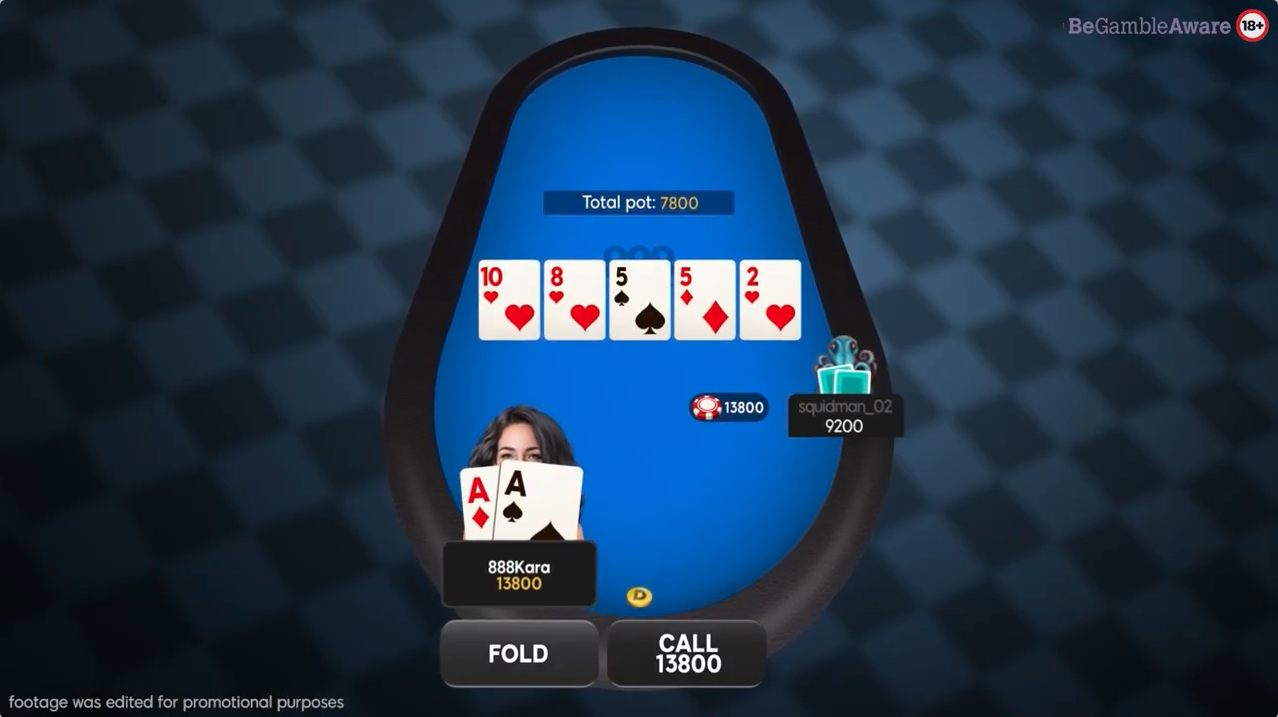
You don't need to commit exclusively to heads-up play to benefit from it. Two common situations in online ring game environments create natural heads-up opportunities.
Scenario 1 – Your table breaks down to two players: Rather than leaving to find a fuller table, consider staying if your remaining opponent looks weak. A few heads-up hands against soft opposition can be more profitable than joining a table of regulars.
Scenario 2 – You can't find enough tables to reach your usual multi-table volume: Start an empty table and be willing to play heads-up when someone joins. Ring game regulars are often reluctant to play heads-up, so players who sit at a half-empty table tend to skew weaker. Starting your own table is usually better than joining a waiting list for one already full of seasoned players.
What Is Bum-Hunting in Poker?
Bum-hunting is the practice of exclusively targeting the weakest players at dedicated heads-up tables and refusing to play anyone stronger. It's considered predatory behaviour and is looked down upon by many players and some operators.
The line between smart table selection and bum-hunting depends largely on context:
- Table selection (recommended): choosing to sit in games where you have an edge, including heads-up spots that arise naturally in ring games.
- Bum-hunting (frowned upon): sitting at a dedicated heads-up table and only accepting a match when a specifically weak player sits down, refusing everyone else.
On a ring game table where anyone can join at any time, targeted game selection is simply good practice. On a dedicated heads-up table, the same behaviour crosses into bum-hunting territory. The goal is to select games intelligently without crossing ethical lines, and to be aware that poker rooms monitor this pattern.
Is Heads-Up Cash or SNG Better?
Heads-up cash games are generally better for exploiting a skill edge. Here's why:
- Consistent stack depths: Cash games typically start at 100bb with the option to rebuy, keeping postflop play deep and complex throughout, where skill edges are largest.
- Simpler strategy: A consistent starting condition means your poker hand ranges and approach stay stable across all tables.
- No blind pressure: In heads-up SNGs, escalating blinds eventually push both players into push/fold territory, where pre-solved ranges dominate and edges shrink considerably.
Multi-tabling SNGs adds further complexity: you could have several tables running at different blind levels simultaneously, requiring different strategic approaches on each.
That said, if heads-up cash games aren't available due to traffic, SNGs are a viable alternative. Their winner-takes-all structure removes ICM complexity, making them function similarly to cash games, aside from the rising blinds.
Does Rake Affect Heads-Up Poker Profitability?
Yes, rake is a significant factor in heads-up play, especially at lower stakes.
In a 6-max or full-ring game, you fold most hands and only enter the pot with something worth playing. In heads-up play, you're entering the pot well over 50% of the time, including many marginal spots. Paying rake on all of those adds up quickly.
A room that applies the same rake structure to heads-up games as to 6-max games is effectively charging you far more per hour of real play. The rule of thumb:
- At 100nl and above, heads-up cash games are nearly always viable.
- At lower limits, the rake can make heads-up cash games borderline or unprofitable.
- If cash rake isn't favourable at your stakes, heads-up SNGs may be the more cost-efficient option.
Always check the rake structure of a specific room before committing to heads-up cash games at the micro or low stakes.
How Do Positions Work in Heads-Up Poker?
In heads-up poker, the button and the small blind are the same player. This is different from ring games and is a common source of confusion.
Here's how it works:
- The button (BTN) posts the small blind and acts first preflop.
- The big blind (BB) acts last preflop.
- Postflop, the order reverses: the button acts last on every street, giving them a positional advantage for the entire hand.
In a ring game, the small blind acts before the big blind both preflop and postflop. In heads-up, the small blind (button) acts last postflop. This distinction is critical for understanding why the button holds such a strong positional advantage in heads-up play.
Heads-Up Preflop Strategy: Ranges and Adjustments
With only two positions, the number of preflop configurations is far smaller than in ring games. At a minimum, you need four core ranges:
- BTN opening range: Open 70–80% of holdings for a min-raise (2bb). This reflects appropriate respect for a competent opponent. Against an exceptionally weak player, opening 100% is defensible, though modern poker solvers suggest 70–80% is closer to optimal by default. Traditionally, professionals defaulted to 100% and tightened if necessary. That approach has been largely abandoned as solver work matured.
- BB cold-call / 3bet range: Call around 50% of hands, 3bet around 15%. Call less against opens larger than 2bb.
- BTN call-3bet / 4bet range: Continue with around 45% of hands – roughly 70% calls, 30% 4bets.
- BB call-4bet / 5bet jam range: Continue around 45% of the time. 5bet jam strong premiums: TT+ and AQs+.
Two situations will require deviations from these defaults: your opponent changes their open-raise size on the button (adjusting your defence frequency accordingly), or your opponent chooses to limp the button instead of raising.
Ring game configurations like playing a 3bet pot in position as the preflop aggressor don't exist in heads-up unless the button limp-raises, which is rare at any serious level.
Heads-Up Postflop Strategy: Exploit Over Balance
In heads-up poker, exploitative play outperforms balanced (GTO poker) play against most opponents.
Both players reach the flop with wider ranges than in ring games, but core postflop skills transfer well – hand reading, board texture analysis, and bet sizing all apply. The key difference is pace: reads accumulate much faster in heads-up play, creating earlier opportunities to exploit weaknesses.
The right response is not to play a balanced strategy. Against most opponents, that leaves money on the table. The question isn't whether to exploit, but where.
- Avoid obvious high-frequency exploits: 3betting 100% of your hands, for example, will be detected quickly because it comes up constantly. Your opponent adjusts, and the edge disappears.
- Target low-frequency spots: Weighting your river triple-barrel range heavily toward bluffs or value, depending on your opponent's tendencies, is much harder to detect. That part of the game tree doesn't appear often enough for most opponents to identify and adjust before the damage is done.
Against stronger opponents, the same principle applies – you're looking for smaller edges and exploiting them more subtly. If your read is that your opponent makes rapid, accurate adjustments to your tendencies, that's also a signal to reconsider the match-up entirely.
FAQ – Heads-up Poker
What hands should I open with in heads-up poker?
On the button, open 70-80% of your holdings for a min-raise (2bb). This is a wide range that includes most playable hands. Against very weak opponents, opening 100% is defensible. From the big blind, defend around 65% of the time against a min-raise – roughly 50% calls and 15% 3bets.
Should I play heads-up cash games or heads-up SNGs?
Cash games are generally better for exploiting a skill edge, due to consistent 100bb starting stacks and stable strategic conditions. SNGs introduce escalating blinds that eventually reduce the game to push/fold, compressing edges. Play SNGs if cash game traffic isn't available, or if the rake structure at your stakes makes cash games unviable.
Is heads-up poker higher variance than ring games?
Yes. With only two players, results fluctuate more sharply than in 6-max or full-ring games. Heads-up specialists compensate through rigorous opponent selection and disciplined bankroll management. Both matter more here than in any other format.
What is bum-hunting in poker?
Bum-hunting is the practice of sitting at dedicated heads-up tables and only agreeing to play against specifically weak opponents, refusing everyone else. It's distinct from general table selection (which is sound practice) and carries a negative reputation in the poker community.
:
Key Takeaways
- Heads-up poker is any format where exactly two players compete for the pot – in cash games, at tournament final tables, or in dedicated heads-up formats.
- Win rates of 10-30bb/100 are achievable heads-up, versus 0-4bb/100 in typical ring games, primarily because you control opponent selection entirely.
- Ring game players can benefit from heads-up opportunistically – when a table breaks to two players, or by starting empty tables when multi-tabling.
- Cash games are preferable to SNGs for exploiting skill edges, due to consistent stack depths and simpler strategic conditions.
- Check rake structures before playing heads-up at low stakes – entering the pot 50%+ of the time makes rake a significant cost factor.
- In heads-up, the button is also the small blind and acts last postflop – the opposite of ring game small blind mechanics.
