

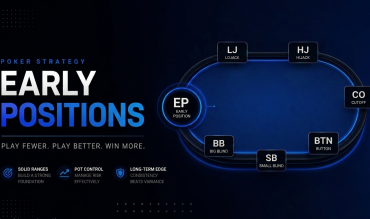

The early positions in a full ring poker game are UTG, UTG+1, UTG+2, and MP1 – the four seats that act first preflop and almost always play out of position postflop. They are unique to full ring (9-10 handed) games and demand the tightest ranges at the table.
What Is Under the Gun (UTG)?
Under the Gun (UTG) is the player seated directly to the left of the big blind. UTG acts first on every preflop street and third postflop (assuming both blinds remain in the hand). The position rotates clockwise after each hand as the dealer button moves.
In a 9-handed full ring game, UTG is the first of four early positions: UTG, UTG+1, UTG+2, and MP1. In 6-max games, the Lojack seat functions as UTG, but with fewer players behind, the strategic constraints are less severe.
The name has two accepted origins. The more common explanation is that acting first means acting under pressure, with no information about any other player's holding. The second traces back to Wild West poker: in ante-only games without blinds, the player to the dealer's left acted first and was the one most likely to have a gun aimed at them by the dealer if cheating was suspected.
Why Are the Early Positions So Difficult?
Playing from EP carries structural disadvantages that cannot be overcome with aggression alone:
- 6-9 players act after you preflop, making blind steals highly unlikely.
- Open-raising ranges from EP are well-known to be tight – opponents respond accordingly with strong continuing ranges.
- You will almost always be out of position postflop against anyone who calls or 3bets.
- Cold calls are easily squeezed or overcalled by players with position still to act.
- 3bets can face a cold 4bet from multiple players behind.
The objective from these seats is not to generate large profits, but to avoid large losses and extract maximum value from the premium poker hands that do arrive. Do not enter the pot without a strong holding.
Key Frequencies From the Early Positions
- Raise-first-in (RFI): ~7% from UTG, up to ~11% from MP1
- Cold call frequency: ~3%
- 3bet frequency: ~3%
These figures account for a range of open-raise sizings. Cold calling and 3betting are a small part of EP strategy by design.
Sample Ranges From the Early Positions
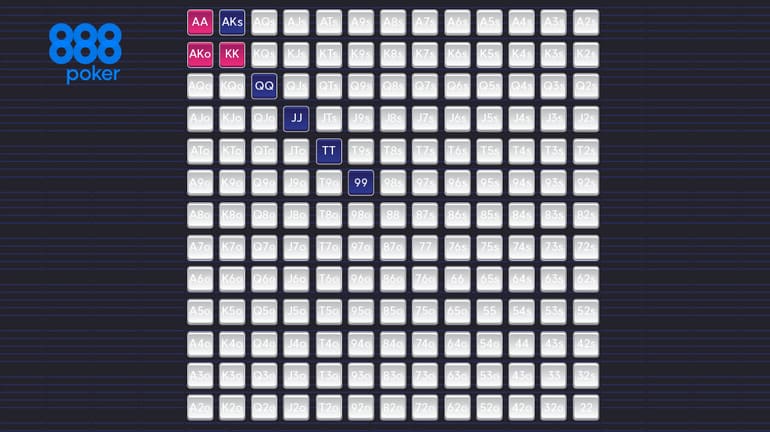
EP Defence vs EP Open
- Pink: 3bet (re-raise) range
- Blue: Cold call range
When facing an early position open, both the 3bet and cold call ranges are tight. The 3bet range is weighted heavily towards high-equity holdings – 3bet bluffing speculative hands is not incentivised in most player pools, as the average opponent does not fold enough to 3bets to make it profitable. Cold calls are constrained by the squeeze and overcall threat from players still to act. Defending range widens slightly against later-position openers, but the difference is minimal from EP.
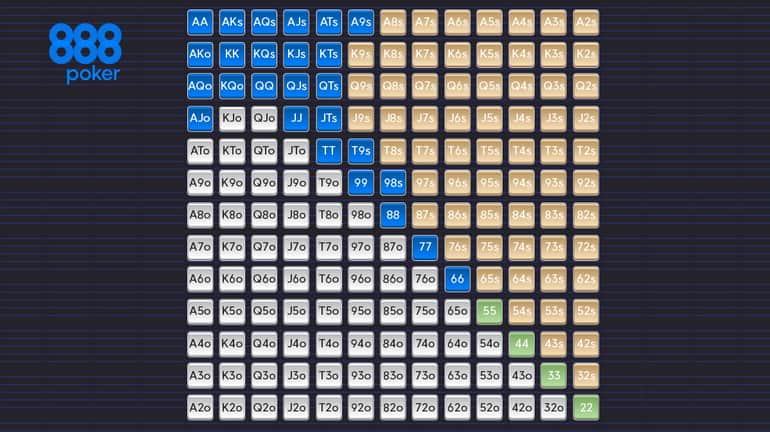
MP1 Raise-First-In Range (~11%)
Raise-first-in (RFI) means open-raising after all players before you have folded. MP1 is the widest early position – at ~11%, this range already tests the limits of what is exploitatively defensible. Expanding beyond this gives observant players behind a profitable 3betting opportunity.
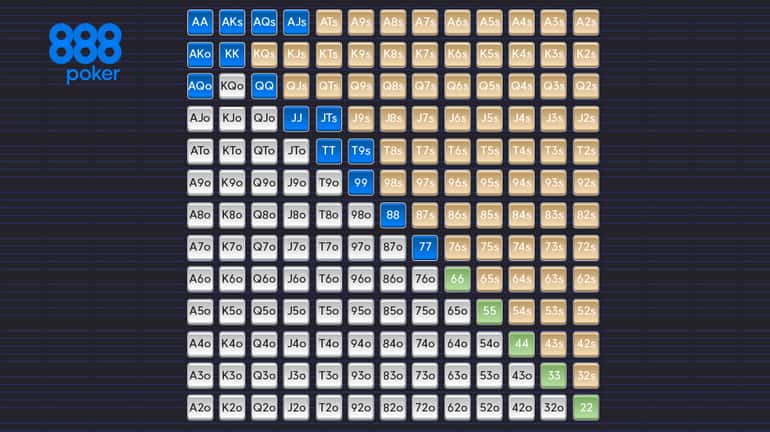
UTG Raise-First-In Range (~7%)
UTG demands the tightest opening range at the table. UTG+1 and UTG+2 open with ranges that fall between these two extremes.
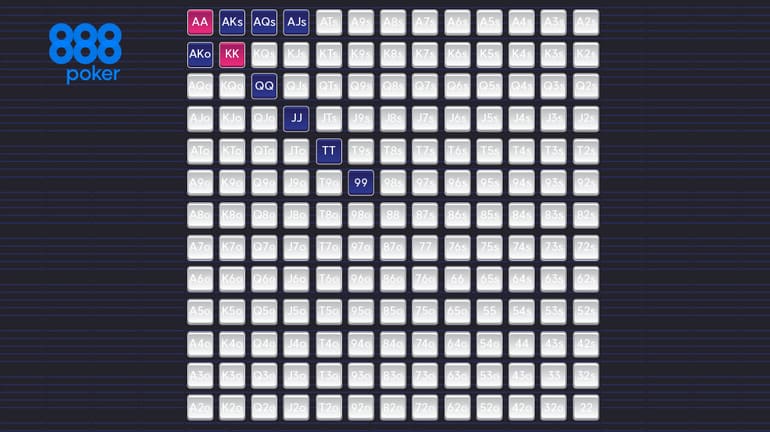
Facing a 3bet From the Blinds
- Blue: Call vs 3bet
- Pink: 4bet (re-raise) vs 3bet
When the 3bet comes from the SB or BB, there is slightly more room to continue. The 4bet range stays weighted towards high-equity value hands. 4bet bluffing is not incentivised in most environments, as the average opponent does not fold enough to 4bets to make bluffs profitable. If you are in MP1 rather than UTG, you can defend slightly wider.
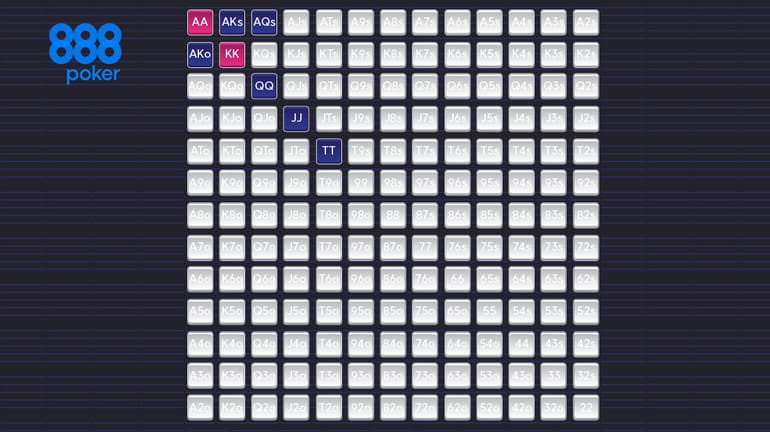
Facing a 3bet From the BTN or CO
- Blue: Call vs 3bet
- Pink: 4bet (re-raise) vs 3bet
A late-position 3bet against a UTG open represents a stronger poker hands range than a blind 3bet – the BTN and CO know your EP range is tight and adjust accordingly. Respond with a tighter continuing range than you would vs the blinds. The same 4bet principle applies: value-heavy only.
Relevant Adjustments
The sample ranges above are a baseline, not a fixed rule. These variables should shift your decisions in real time:
- Villain's sizing – The larger the open raise or 3bet, the tighter you defend.
- Opener's position – The later the opener's position, the wider you can defend. The difference is small from EP either way.
- Reads – If an opponent folds too much to 3bets or 4bets, increase aggression accordingly.
- Villain skill – Weaker players justify playing more hands in general, but expansion from EP is still heavily limited.
- Players behind – If habitual folders occupy the later positions, RFI range can expand slightly. The effect is minimal from EP.
Additional EP Spots: Straddles, Limpers, and 3bet Dynamics
Iso-Raising From EP
An iso-raise is a preflop raise made against an open limper. From EP, iso-raising ranges closely mirror RFI ranges but lean more towards high-equity holdings – big cards over suited connectors – given the number of players still to act. Iso-raising from these seats is only possible in full ring games, as EP is the earliest position in short-handed formats.
Overcalling and Squeezing From EP
An overcall is a call after another player has already called on the current street. A squeeze is a 3bet made after at least one caller has already acted vs an open raise. Both are full-ring-only scenarios from EP.
Overcall ranges from EP weight towards speculative hands with suited or connected potential. Squeeze ranges stay tight and value-heavy – both follow the same principles as standard cold-call and 3bet ranges from these seats. Because these situations are relatively rare from EP, maintaining separate strategies is not critical in most games.
The Straddle
A straddle is a voluntary third blind (typically 2x the big blind) most commonly posted by the UTG player. Once posted, preflop action starts to the left of the straddler, so UTG acts last preflop. Straddling effectively halves all effective stack sizes in terms of big blinds, creating shallower postflop stack-to-pot ratios. Straddling from UTG is generally –EV: chips are committed blind from the seat with the worst postflop position at the table.
Open-Limping and Limp-Raising
Open-limping from UTG is not part of a sound long-term strategy. Limp-raising big hands turns your holding face-up and weakens your open-raising range, which should represent the strongest range at the table when you do raise. The limp-raise is only defensible exploitatively if there is a reliably aggressive player directly to your left and most of the remaining table tends to call and see flops.
Responding to Aggressive 3bettors: The Levelling War
A competent opponent 3betting you from UTG understands that your range is strong. That awareness means their 3betting range is also stronger than it would be vs other positions. The default response is caution. Against a known aggressive 3bettor, adding bluff 4bets with hands like A5s or AQo, which block AA and AK while retaining postflop playability, can be a viable adjustment.
Key Takeaways
- The early positions (UTG, UTG+1, UTG+2, and MP1) are unique to full ring games and demand the tightest ranges at the table.
- RFI runs from ~7% (UTG) to ~11% (MP1). Cold call and 3bet frequencies are both ~3%.
- 3bet and 4bet ranges from EP are value-heavy in both directions – bluffing with speculative holdings is rarely profitable in standard player pools.
- When facing a 3bet, respond tighter vs late-position 3bettors (BTN/CO) than vs blind 3bettors (SB/BB).
- Adjust ranges based on sizing, opponent tendencies, reads, and field composition, but expansion from EP is always limited.
- Open-limping, limp-raising, and straddling from UTG are –EV in almost all circumstances.
