



7 Card Stud is a fixed-limit poker variant in which each player receives up to seven individual cards – three face-down and four face-up – across five betting rounds, with no community cards. The best five-card hand at showdown wins the pot.
What Is 7 Card Stud?
Dating back to the mid-1800s, 7 Card Stud was the most widely played form of poker until Texas Hold'em took over in the 1980s. Unlike Hold'em, there are no community cards: each player builds their own hand independently. Because each player can receive up to seven cards, a maximum of eight players can sit at a Stud table at any one time.
Most games use a fixed-limit format. A smaller bet applies on 3rd and 4th Street; the bet doubles from 5th Street onwards. There are no blinds. Instead, every player posts an ante before each hand, and the player with the lowest door card posts a forced bet called the bring-in.
How to Play 7 Card Stud
A hand of 7 Card Stud consists of five betting rounds across seven cards dealt. Cards 1-2 are dealt face-down; card 3 (3rd Street) is dealt face-up. From 4th to 6th Street, one more face-up card is added each round. The 7th Street card is dealt face-down. At showdown, each player picks their best five cards from the seven received.
Antes and Bring-In
Every player posts an ante before the deal. Two hole cards and one face-up door card are then dealt to each player. The player showing the lowest door card by suit must post the bring-in. Suit ranking from worst to best: ♣️ Clubs → ♦️ Diamonds → ♥️ Hearts → ♠️ Spades. The 2♣️ is the worst possible door card. Note that suit ranking only applies to the bring-in; suits carry no weight at showdown.
3rd Street – First Betting Round
The bring-in player acts first. They can post the minimum bring-in or complete to the full lower-limit stake. Completing is not a raise. Once the bet is completed, up to three raises are permitted. Action moves clockwise: players may fold, complete, or raise.
4th Street – Second Betting Round
A second face-up card is dealt. From this point on, the player with the best upcards acts first in every remaining street – ties broken by card-receipt order. Betting remains at the lower limit. If any player shows an open pair, any player at the table may choose to bet the upper limit instead. Players may check, bet, call, raise (capped at 4 raises), or fold.
5th Street – Third Betting Round
A third face-up card is dealt. The minimum bet doubles to the upper limit from here on and stays there for the rest of the hand. Players may check, bet, call, raise (capped at 4 raises), or fold.
6th Street – Fourth Betting Round
A fourth face-up card is dealt. Each active player now has four cards face-up and two in the hole. Betting continues at the upper limit. Players may check, bet, call, raise, or fold.
7th Street (The River) – Fifth Betting Round
The final card is dealt face-down. Betting continues at the upper limit. If too few cards remain in the deck for all active players, the dealer does not burn and deals a single community card face-up in the centre of the table for all players to share.
Showdown
Any player who remains after the final betting round proceeds to showdown. Each player selects their best five cards from the seven dealt. Standard poker hand rankings apply: Royal Flush (best) through High Card (worst). Suits do not affect hand rankings at showdown; they only determine the bring-in on 3rd Street.
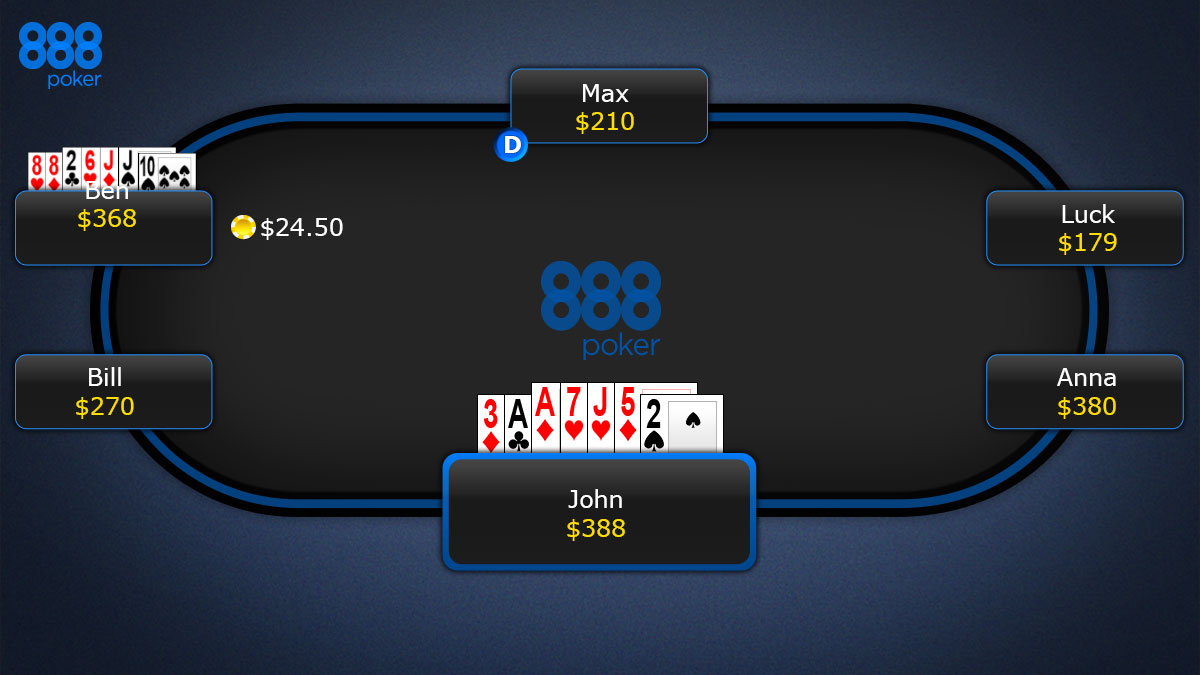
7 Card Stud Rules
- If the dealer exposes one hole card, the third card is dealt face-down instead. If both hole cards are exposed, the hand is dead and the ante is returned.
- On 3rd Street, the bring-in is determined by the lowest door card by suit. From 4th Street onwards, the highest hand showing acts first; ties are broken by card-receipt order.
- Completing the bring-in to the lower-limit stake is not a raise.
- On 4th Street, any player may bet the upper limit if an open pair is showing, even if no bet has been placed yet.
- If a hand is folded before a bet is placed, that seat continues to receive cards until the hand is killed by a bet. This prevents folded cards from altering what active players receive.
- The dealer is responsible for announcing the low card, the high hand, all raises, and all pairs.
- If insufficient cards remain on the river, the last card is shuffled with the burn cards. If there are still not enough cards, the dealer skips the burn and deals a single community card face-up for all active players to use.
- A hand with more or fewer than seven cards at showdown is dead, regardless of fault. Exception: a player missing their 7th Street card may have their hand ruled live.
How a 7 Card Stud Hand Plays Out: Example
Eight players each post the $0.50 ante in a $2/$4 game. Two hole cards and one door card are dealt. Seat 2 shows the 2♦️ (the worst door card) and posts the $1 bring-in. Seats 3-7 fold; Seat 8 completes to $2; Seat 1 calls; Seat 2 folds. The hand continues heads-up.
- 4th Street: Seat 1 shows A♦️–2♣️ (best hand); Seat 8 shows K♠️–J♠️. Seat 1 checks, Seat 8 bets $2, Seat 1 calls.
- 5th Street: Seat 1 receives the K♦️; Seat 8 receives the 9♠️. Seat 1 checks, Seat 8 bets $4 (upper limit now in effect), Seat 1 calls.
- 6th Street: Seat 1 receives the 2♥️; Seat 8 receives the J♦️. Seat 1 check-raises to $8; Seat 8 calls.
- 7th Street: Both players receive a face-down card. Seat 1 leads for $4; Seat 8 raises; Seat 1 calls.
Showdown:
- Seat 8: 8♠️ Q♠️ K♠️ J♠️ 9♠️ J♦️ 10♠️ → Jack-high Straight Flush
- Seat 1: K♣️ J♣️ A♦️ 2♣️ K♦️ 2♥️ 3♠️ → Two pair, Kings and Twos
Seat 8 wins with a jack-high Straight Flush.
Other Stud Variants
Seven Card Stud Hi-Lo Eight or Better: The best high hand and the best qualifying low hand each take half the pot. A qualifying low hand requires five unpaired cards of 8 or lower. If no low hand qualifies, the high hand scoops the entire pot. All betting rules are identical to standard 7 Card Stud.
Razz poker: Seven Card Stud played exclusively for the lowest hand. The best possible hand is 5-4-3-2-A. Razz features regularly at the World Series of Poker and in dealers' choice cash games.
Caribbean Stud Poker: A casino table game based on Stud rather than a poker room variant. Each player receives five cards face-down; the dealer receives four face-down and one face-up. The objective is simply to beat the dealer's hand. Similar in structure to blackjack.
Key Takeaways
- 7 Card Stud uses no community cards – each player builds their own hand individually.
- Maximum eight players per table.
- No blinds: an ante plus a bring-in (posted by the player with the lowest door card) open each hand.
- Five betting rounds: 3rd, 4th, 5th, 6th, and 7th Street.
- Bets are at the lower limit on 3rd and 4th Street; they double permanently from 5th Street.
- An open pair on 4th Street gives any player the option to bet the upper limit early.
- From 4th Street onwards, the player with the best upcards acts first.
- Best five cards from seven win at showdown; standard hand rankings apply.
- A hand with more or fewer than seven cards at showdown is dead (one exception applies).
- If cards run short on the river, a single community card is dealt face-up for all players.
